
Contents
1. How to Prepare for an Administrative Appeal or Administrative Lawsuit After a Special Naturalization Rejection
2. Everything You Need to Check for a Naturalization Application
3. Why Should You Apply for Naturalization with Majung?
1. How to Prepare for an Administrative Appeal or Administrative Lawsuit After a Special Naturalization Rejection
If you wish to settle in Korea and establish your identity as a Korean citizen, applying for naturalization may be a path to consider.
Before beginning the naturalization process, it's essential to clearly understand the requirements and procedures and to thoroughly prepare all necessary documents .
In particular, special naturalization tends to have stricter screening criteria compared to general naturalization, and filing an application does not guarantee approval.
Even if you meet the legal requirements, you may still be denied due to unexpected reasons.
Recently, Majung, a law firm specializing in foreign nationals, received a consultation request from someone who had been denied special naturalization.
The client, who has been living with a Korean spouse and Korean child, applied for naturalization but was denied due to a previous non-contact traffic incident (caused by a traffic signal violation), which resulted in a suspended prosecution.
Believing that the rejection was overly harsh given the circumstances, the client requested legal support for an administrative appeal.
A record of legal violations, even minor ones, can be grounds for rejection.
However, if the circumstances are explained properly and if there is genuine remorse and mitigating factors, the applicant may seek a new judgment through an administrative appeal or lawsuit.
Just like the case above, Majung, a law firm specializing in foreign nationals, offers legal assistance for those experiencing difficulties in the naturalization process due to various incidents or legal issues.
2. Everything You Need to Check for a Naturalization Application
① About the Requirements for Special Naturalization
Foreign nationals who have never acquired Korean nationality can obtain it through the naturalization process.
There are three types of naturalization in Korea: General Naturalization, Simplified Naturalization, and Special Naturalization.
Among them, special naturalization is a system where certain requirements are relaxed if specific conditions are met.
To apply for special naturalization, certain qualifications must be met. The applicant must meet at least one of the conditions listed below and must reside in Korea.
Eligibility for Special Naturalization
In this article, we will focus on two of the three special naturalization categories:
Individuals whose parent (father or mother) is a Korean national
Individuals who have made a special contribution to Korea
② Special Naturalization for Children of a Korean Father or Mother
To apply for special naturalization as the child of a Korean father or mother, both general requirements and additional specific conditions must be met.
If an applicant displays poor conduct or lacks the ability to understand or speak Korean, the naturalization application may be rejected.
Furthermore, unless exempt, all applicants must pass the Social Integration Program Comprehensive Evaluation and an interview assessment.
The only exemption from these evaluations applies to applicants under the age of 15.
These evaluations are designed to assess whether the applicant can successfully adapt to Korean society, respect its culture and laws, and positively contribute to the country and community.
Additional Eligibility Criteria for Special Naturalization (as a child of a Korean parent)
If these conditions are met, the individual may apply for naturalization under this special category.
③ Required Documents for Naturalization Application
When applying for naturalization, the following key documents are required.
Family Relationship Notification Form (a handwritten form to be submitted to the Supreme Court)
Copy of Passport
One Photo
Criminal Record from your home country (Must be apostilled or verified by the Ministry of Foreign Affairs or the Korean consulate)
Birth certificate from your home country, notarized family relationship documents, or court rulings proving biological relationship
DNA Test Results
Basic Certificate, Marriage Certificate, and Family Relationship Certificate of the Korean parent
Applicants must prepare these documents and submit them to the local immigration office.
If the applicant has minor children, their naturalization applications can be submitted together with the parents'.
As of January 2025, the naturalization review period for children of naturalized citizens is reported to be approximately 19 months, highlighting the importance of carefully preparing all required documents.
If you find it difficult to prepare the necessary paperwork, it is recommended to seek help from a specialized administrative officer experienced in assisting foreign nationals.
Finally, once the naturalization is approved, the applicant must attend the oath of allegiance and nationality certificate ceremony to officially acquire Korean citizenship.
④ Special Naturalization for Those with Distinguished Merits to the Nation (National Meritorious Persons)
In principle, foreign nationals must meet the general requirements for naturalization as stipulated in Article 5 of the Nationality Act.
However, for certain individuals—such as descendants of independence patriots—some requirements, such as the period of residence, can be waived under the special naturalization system.
Let’s take a look at the eligibility for special naturalization for individuals with distinguished contributions to Korea.
Who qualifies as a person with “special contributions to Korea”?
As outlined above, the special naturalization system plays an important role in granting Korean nationality to foreigners who have made outstanding contributions to Korea, or those with Korean lineage through a Korean father or mother.
This system helps Korea attract highly capable individuals in various fields and enhances the nation's global competitiveness.
While the process and requirements for special naturalization can be somewhat complex and strict, thorough preparation and complete submission of all required documents are essential.
Since the review evaluates whether the applicant can positively contribute to Korean society, it’s important to fully understand the criteria and prepare accordingly.
3. Why Should You Apply for Naturalization with Majung?
If you want a new beginning in South Korea, naturalization may be the way to realize that dream.
The procedures and requirements for naturalization can be relatively complex and strict. If you are considering applying for naturalization, thorough preparation and accurate submission of documents are essential.
Since there are many documents to prepare during the naturalization process, trying to handle everything alone may lead to unexpected challenges.
If you receive a rejection for special naturalization, you may need to proceed with administrative appeals or litigation, making it wise to seek professional assistance.
With expert advice and systematic preparation, your naturalization application can be reviewed more effectively and potential issues can be identified in advance.
Although many administrative offices in Korea handle nationality-related tasks, it is not easy to find a specialist who systematically handles naturalization cases involving foreign nationals.
General administrative officers handle a wide range of administrative tasks and may lack sufficient expertise in immigration and naturalization procedures.
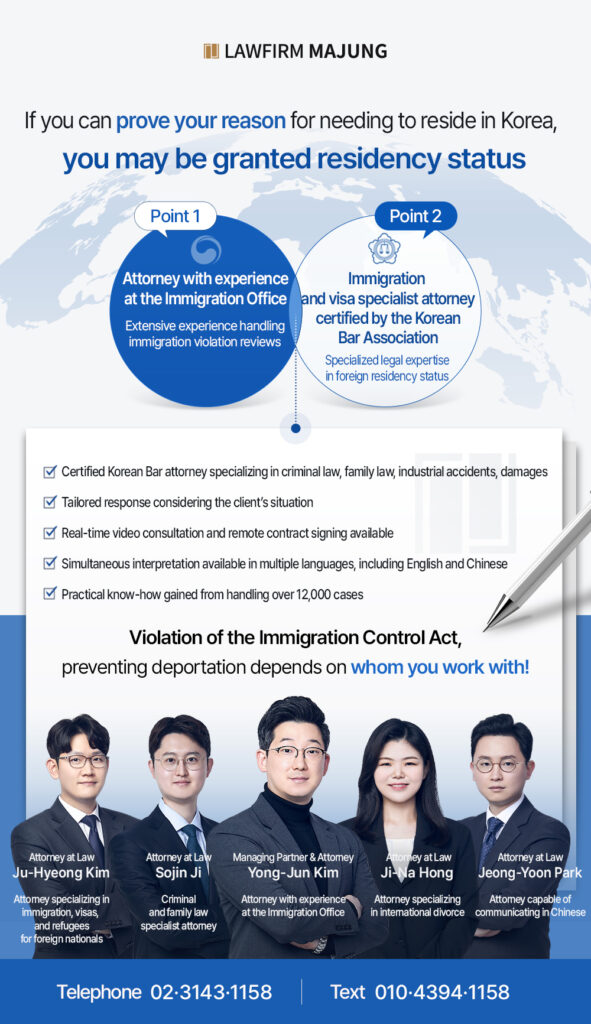
Majung, a law firm specializing in foreign nationals, is staffed by experts in immigration law who provide professional support for the naturalization process.
Don’t face the legal system alone. Let Majung support you throughout your naturalization process.