법률칼럼

Legal Insights

Legal information on immigration, visas, criminal defense, and international divorce for foreign nationals.

법률칼럼Legal InsightForeigner2026. 05. 19

Requirements for Foreigners to Apply for Naturalization in Korea and Administrative Litigation Process When Korean Citizenship is Denied

Applying for Naturalization in Korea Without Preparation Can Lead to Rejection For foreigners who have established a sta

썸네일

Applying for Naturalization in Korea Without Preparation Can Lead to Rejection

For foreigners who have established a stable life in Korea, it’s common to consider acquiring Korean citizenship after obtaining permanent residency.

However, acquiring Korean nationality is not a simple process that ends with submitting an application. Applicants must meet a range of detailed requirements, including residency period, good conduct, financial stability, and proficiency in the Korean language and understanding of Korean culture.

Failing to meet even one of these criteria can result in a rejection. In such cases, the applicant may need to reapply or even pursue administrative litigation.

In particular, proving good conduct, residency history, and financial stability requires strategic preparation. Therefore, it's highly advisable to plan with an experienced legal representative to improve your chances of success.


Contents

1. Foreigners' Naturalization: Eligibility and Requirements by Type

2. Naturalization Application Process for Foreigners and Essential Documents

3. Key Evaluation Criteria and Reasons for Rejection in the Korean Naturalization Review Process

4. Korean Naturalization: Response Strategies After a Rejection Notice

5. Korean Naturalization: Final Checklist Before Completing the Process


1. Foreigners' Naturalization: Eligibility and Requirements by Type

Korean Naturalization Requirements: General, Simplified, and Special Naturalization

Korean naturalization is divided into three categories: General Naturalization, Simplified Naturalization, and Special Naturalization.

Each type has different requirements related to residence duration, family relationships, and contributions to the country.

Choosing the correct type based on your personal situation is the first step to increasing your chances of approval.

① General Naturalization

This route is for foreigners who do not have any special ties to Korea. It is considered the most difficult type in terms of screening.

CHECK POINT
Residency Requirement
Must have continuously resided in Korea for at least 5 years. (Extended absences during this period may not be counted.)
Visa Status
Must hold F-5 permanent resident status.
Good Conduct
No criminal record or history of violating immigration laws.
Economic Stability
The applicant or their family must have income or assets exceeding the minimum cost of living.
Basic Knowledge
Must pass an evaluation of Korean language skills, history, and cultural understanding.

② Simplified Naturalization

This type is based on family relationships or long-term residence, and has relaxed requirements compared to general naturalization.

CHECK POINT
Marriage-Based Naturalization
• Lived in Korea continuously for 2 years or more after marrying a Korean citizen, or
• Married for 3 years and has lived in Korea for at least 1 year.
Bloodline/Birth Criteria
• If one parent is Korean, or the applicant was born in Korea and has resided for a long time.
CHECK POINT
Adoption-Based
• Foreigners adopted by a Korean national.
i
Important
In marriage-based applications, fake marriages are strictly screened. You must provide solid proof of a genuine marital relationship.

③ Special Naturalization

This is a pathway for individuals who have made significant contributions to the country, or who are otherwise specially recognized under Korean law.

CHECK POINT
Contribution-Based Eligibility
• Direct descendants of independence patriots or national heroes, or individuals who have contributed to Korea in culture, sports, science, etc.
Residency Requirement
• The Minister of Justice may waive residency requirements when appropriate.
i
Important
You must prepare and submit official documents that prove your contributions to the nation.

Since the requirements for Korean naturalization vary by type, carefully reviewing all conditions in advance and preparing the necessary documents early will significantly increase your chances of success.
2025-외국인센터-간략발행이미지_출입국_01_영문-640x1024

2. Naturalization Application Process for Foreigners and Essential Documents

Once a foreigner applies for naturalization, their residency history, conduct, financial capability, and basic knowledge are comprehensively reviewed. Approval is granted only if all criteria are successfully met.

PROCESS
Korean Naturalization Application Process
Step 1
Eligibility Check
First, determine the type of naturalization that applies to your situation, then carefully review the relevant Korean naturalization requirements.
Step 2
Document Preparation
If you fail to submit the appropriate documents, the review process may be delayed or your application may be rejected.
CHECK POINT
Documents
• Application form, copy of passport and alien registration card, ID photo, proof of stay history
Residence
• Resident registration certificate, certificate of alien registration
Conduct
• Criminal background checks from Korea and the home country, immigration law violation records
Financial Stability
• Income certificate, property tax payment certificate, employment contract
Basic Knowledge
• TOPIK score report or certificate of completion from the Social Integration Program
PROCESS
Step 3
Submission and Initial Review
If no corrections or additional documents are required during the first-stage document review, the applicant will proceed to an interview and basic knowledge test.
Step 4
Conduct, Financial, and Public Safety Screening
Authorities will assess criminal records, economic stability, and how well the applicant has adapted to Korean society.
Step 5
Approval and Acquisition of Korean Nationality
Once naturalization is approved, the applicant must report their acquisition of Korean nationality and complete resident registration to officially become a Korean citizen.
2025-외국인센터-간략발행이미지_출입국_02_영문-529x1024

3. Key Evaluation Criteria and Reasons for Rejection in the Korean Naturalization Review Process

The Korean naturalization review process goes beyond simply checking whether an applicant meets the basic requirements. Authorities conduct a comprehensive evaluation to determine whether the applicant can adapt to Korean society and does not pose a risk to public safety.

If the applicant fails to meet legal standards during this review, the application may be denied.

CHECK POINT
Common Reasons for Naturalization Rejection
Criminal Record
Serious offenses such as violence, theft, sexual crimes, DUI, and drug-related offenses are considered major red flags and can significantly reduce the chance of approval.
Immigration Law Violations
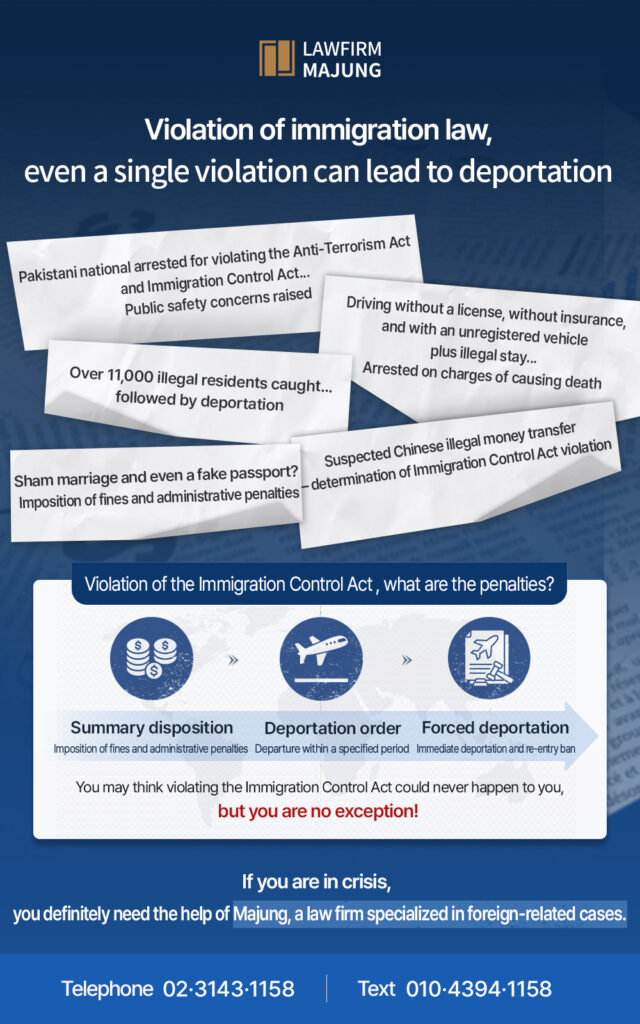
Overstaying, submitting false documents, or engaging in unauthorized activities are viewed as violations of conduct requirements and may lead to rejection.
Financial Instability
Lack of sufficient income or assets, or prolonged periods of unemployment, can result in a determination that the applicant is unable to support themselves.
Poor Social Conduct
Issues such as tax delinquency, alcohol-related incidents, violent behavior, or repeated violations of public order can indicate poor adaptation to society.
Lack of Document Credibility
If the submitted information is false, or if any documents are forged or altered, the application may be immediately denied during the review stage.
i
Important
It is crucial to identify potential risk factors in advance and prepare supporting evidence or written explanations to address any weaknesses in your application.

4. Korean Naturalization: Response Strategies After a Rejection Notice

If your application for Korean naturalization is denied, it is essential to analyze the reason for rejection and carefully plan your next steps.

Reapplying without resolving the issue that led to the denial can result in the same outcome, so a strategic approach is critical.

RESPONSE
01. Filing an Objection
You can submit a written objection to the Ministry of Justice, along with supporting documents that refute the reasons for rejection. At this stage, the focus should be on clarifying the facts related to each issue and providing evidence that addresses any misunderstandings.
02. Administrative Appeal
If you believe the rejection was unjustified or that procedural errors occurred during the review process, you can file an administrative appeal to challenge the decision. It’s important to present both legal grounds and objective evidence that support your claim.
03. Administrative Litigation
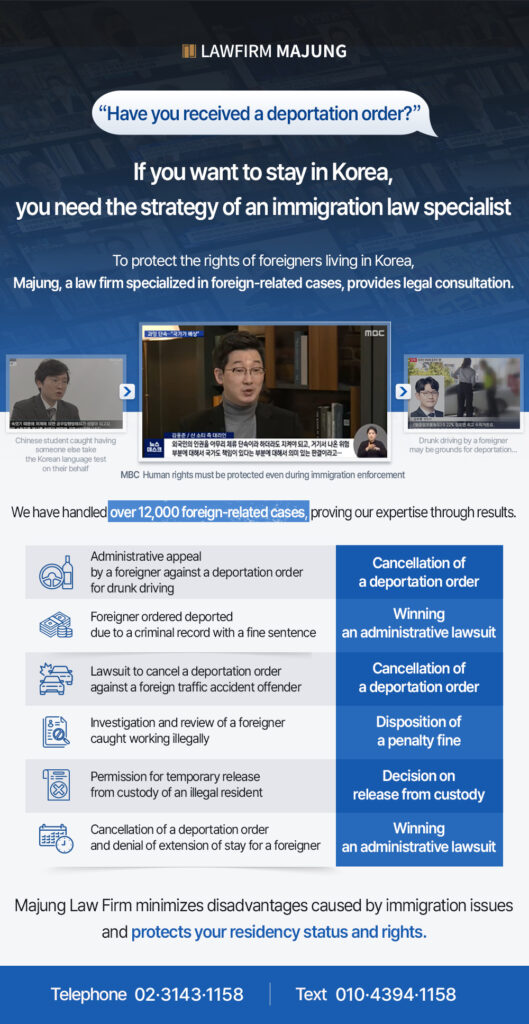
If the outcome of the administrative appeal is still unsatisfactory, or if you wish to go directly to court, you can file an administrative lawsuit to request the cancellation of the rejection. At this stage, the assistance of a legal representative is highly recommended for the best chance of success.
i
Important
Meeting Korean naturalization requirements takes more than just an explanation—it requires objective supporting documents and relevant legal arguments to increase your chances of approval.
2025-외국인센터-간략발행이미지_출입국_03_영문-591x1024

5. Korean Naturalization: Final Checklist Before Completing the Process

If you apply for Korean naturalization without accurately identifying your eligibility and the correct type of application, your chances of receiving a rejection notice are significantly higher.

Acquiring Korean citizenship is not determined solely by meeting basic requirements. The credibility of the submitted documents and the completeness of the application play a critical role in the final decision during the review process.

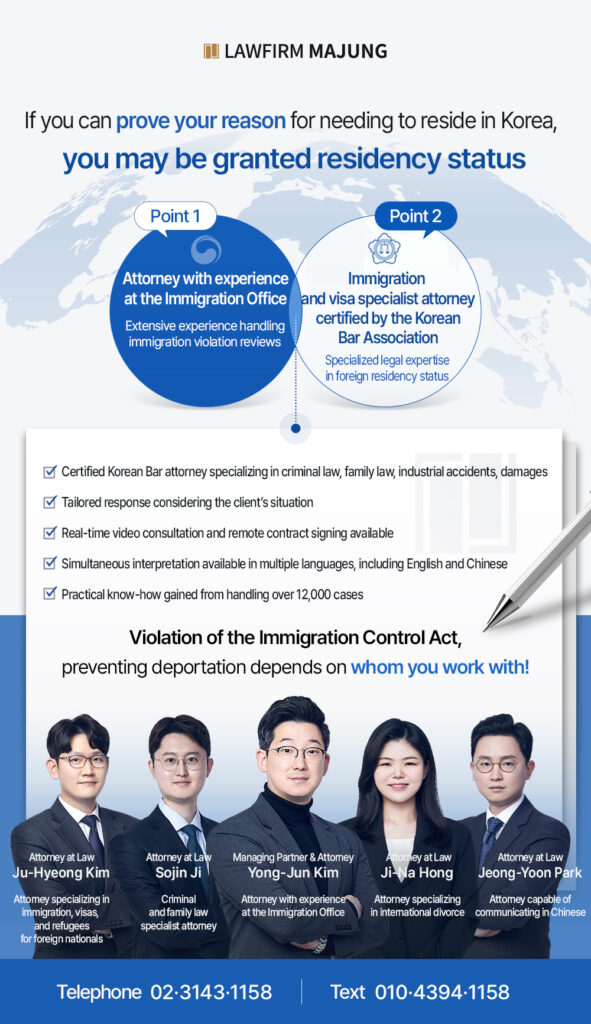
Legal representatives who are certified by the Korean Bar Association and have practical experience with immigration offices can provide strategic support throughout the entire process—from initial eligibility assessment to responding during the review, and even handling rejections.

Korean naturalization has detailed legal requirements, and the burden of proof is high. That’s why preparing your application with an experienced immigration and visa law expert is the safest approach.

i
Final Checklist
By reviewing all requirements in advance and preparing high-quality supporting documents, you can significantly increase your chances of being approved for Korean citizenship.

Thank you.

Multilingual consultation available in English and Chinese.

Professional interpreters assist from the first consultation to the conclusion of the case.

Offices in Seoul, Daejeon, Busan, Daegu, and Gwangju

Don’t face the legal system alone. Let Majung fight for you!

상담 신청하기

Online
Phone KakaoTalk Online