
The asylum application process in Korea is complex and highly selective, making it difficult to obtain approval.
If you are currently preparing to apply for asylum or have already received a rejection notice, it is strongly recommended to work with a legal representative to develop a clear and strategic response plan.
Even minor mistakes during the interview or incomplete documentation can negatively impact the outcome.
Especially after a rejection, legal procedures such as:
must often be pursued in sequence.
That’s why it’s critical to approach the process strategically from the beginning.
Since asylum procedures involve both legal and administrative processes, having the support of an experienced immigration attorney can significantly improve your chances of success.
Even small errors made during the preparation stage can lead to serious disadvantages in later appeals.
Contents
1. What is the meaning of a refugee application, and what is the procedure?
2. What are the key documents required during the application process?
3. What procedures are available if refugee status is denied?
4. What is the role of a legal representative in the refugee application process?
5. What benefits are available upon recognition of refugee status?
6. Refugee application: Strategy and preparation can change the outcome.
1. What is the meaning of a refugee application, and what is the procedure?
Applying for refugee status is a legal procedure through which a foreign national seeks protection in South Korea due to the risk of persecution in their home country.
Common reasons for refusal of refugee status include:
※ “Transit through a safe country” refers to cases where the applicant passed through a country considered safe before arriving in South Korea.
This process is not merely about submitting paperwork—it requires a coherent and persuasive combination of testimony and evidence.
Preparing with this in mind from the outset can significantly influence the outcome of the review.
2. What are the key documents required during the application process?
To apply for this status, it’s important to prepare both core documents and additional materials that support the review process.
This increases the likelihood of a stable and favorable outcome.
3. What procedures are available if refugee status is denied?
Receiving a Refugee Rejection Does Not Mean Immediate Departure.
Being denied refugee status does not automatically require immediate departure from South Korea. The law allows for various relief procedures, including refugee objection applications and administrative litigation.
① Structuring Legal Grounds for the Application
Statements are organized to align with relevant conventions and legal grounds—such as race, religion, nationality, membership in a particular social group, or political opinion—to enhance persuasiveness.
② Selecting and Supplementing Evidence
Effective materials are compiled for the review, and if lacking, support is provided for obtaining, translating, and notarizing additional documents.
③ Interview Preparation
Through analysis of expected questions and mock Q&A sessions, applicants can maintain consistent testimony and avoid unnecessary remarks.
④ Responding to Refugee Status Denial
At the refugee objection and administrative litigation stages, legal grounds are identified and strategies are developed to supplement necessary evidence.
⑤ Handling Emergency Situations
In cases of deportation orders, alternatives such as filing for suspension of execution or applying for humanitarian stay permits are considered.
5. What benefits are available upon recognition of refugee status?
① Upon recognition, the applicant is issued an F-2-4 residence visa, allowing long-term stay in units of 1 to 3 years. This visa can be renewed as long as refugee status is maintained.
② With this status, the individual can legally work at most businesses and companies, although certain fields—such as medical practice—are excluded.
③ Refugees may enroll in the national health insurance system and access welfare services offered by some local governments.
④ If certain conditions are met, they may also apply for permanent residency (F-5) or naturalization.
6. Refugee application: Strategy and preparation can change the outcome.
Applying for refugee status is a legal process that requires meeting specific criteria and providing substantial supporting evidence.
Every element—including eligibility, the credibility of submitted documents, and interview responses—is evaluated comprehensively.
Therefore, it’s crucial to set a clear and accurate direction from the very beginning.
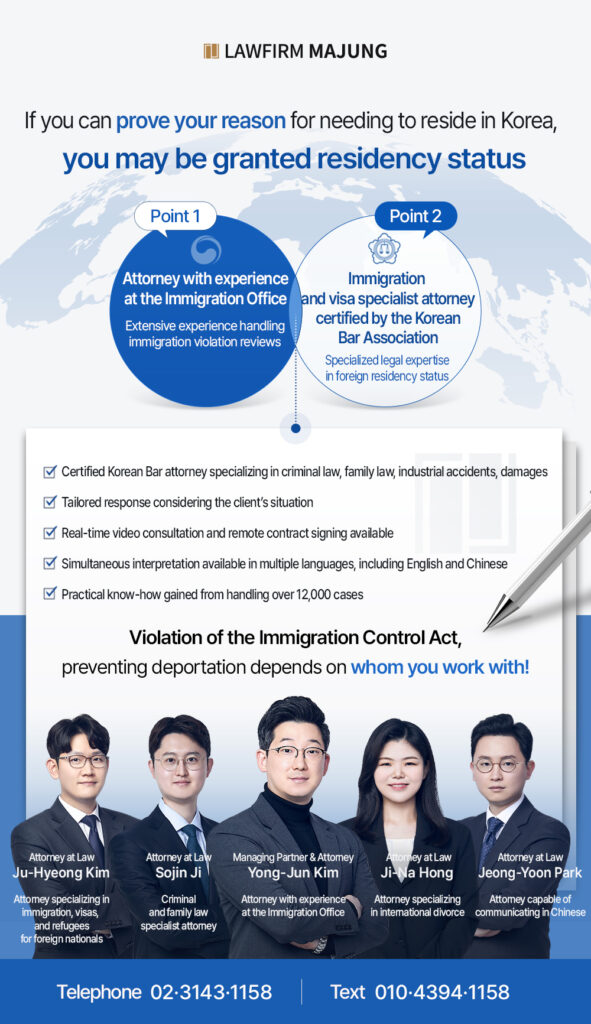
The Korean Bar Association’s Refugee Legal Support Representatives offer stable assistance throughout the entire process— from the initial application stage to objection procedures following a denial, administrative litigation, and even reapplication .
Legal representatives with practical experience at immigration offices can develop strategies that reflect actual review trends and procedures, helping applicants achieve more favorable outcomes.
Refugee applications involve both eligibility assessments and procedural responses, making it a complex process.
Thank you.
Multilingual consultation available in English and Chinese.
Professional interpreters assist from the first consultation to the conclusion of the case.
Offices in Seoul, Daejeon, Busan, Daegu, and Gwangju
Don’t face the legal system alone. Let Majung fight for you!