
Hello,
This is Majung Law Firm.
Foreign nationals residing in Korea may sometimes receive a deportation order from the Korea Immigration Service.
Initially, they may believe that they are simply being questioned by immigration authorities. However, after the investigation, they may unexpectedly find themselves facing a formal deportation order.
For foreigners who are employed in Korea or living with their spouses and children, the possibility of suddenly having to leave the country can create serious concerns about losing their established lives and family relationships.
However, being potentially subject to deportation and whether an actual deportation order has been lawfully issued are two separate matters that must be examined carefully.
|
✔️The deadline for filing an objection to a deportation order is particularly short, making it essential to respond without delay. |
1. Received a Deportation Order? First, Check Its Legal Grounds
Not every foreign national who violates immigration laws or becomes involved in a criminal case in Korea is automatically subject to a deportation order.
Whether an actual deportation order is lawful must be determined by examining its legal basis and the specific facts of the case. The following matters should be reviewed:
|
✅ Identify the specific violation used as the legal basis for deportation. |
|
✅ Determine whether the finding that you are subject to deportation is consistent with the actual circumstances of your case. |
|
✅ Consider your family relationships and established life in Korea. |
In particular, if deportation could result in prolonged separation from your family, the relevant circumstances should be organized and supported by objective documentation.
However, simply having family members or employment in Korea does not automatically mean that a deportation order will be revoked.
Ultimately, if you receive a deportation order, it is more important to examine its legal grounds and identify any factual or legal issues that can be challenged rather than simply requesting leniency.
A lawyer familiar with the Korea Immigration Service and immigration-related proceedings can help review these issues and identify the available legal options.
2. Deportation Orders: The 7-Day Objection and Administrative Litigation Process
One of the first things a foreign national must check after receiving a deportation order is the date on which the order was received.
Under Article 60 of the Korean Immigration Act, an objection to a deportation order must generally be filed within seven days from the date the deportation order is received.
|
👉 If you receive a formal deportation order, you must carefully check both the contents of the decision and the applicable legal deadline. |
|---|
|
① Reviewing an Objection to the Deportation Order |
|
② Considering Administrative Litigation |
|
③ Filing an administrative lawsuit does not automatically suspend the execution of a deportation order. |
|
④ Distinguishing Between a Departure Order and a Deportation Order |
Therefore, if you are considering consulting a Korea immigration service specialist or a lawyer experienced in immigration matters, the first step is to identify the exact type of administrative measure issued and the deadline for responding.
Because the objection period is short, delaying legal review may result in losing an important opportunity to challenge the decision.
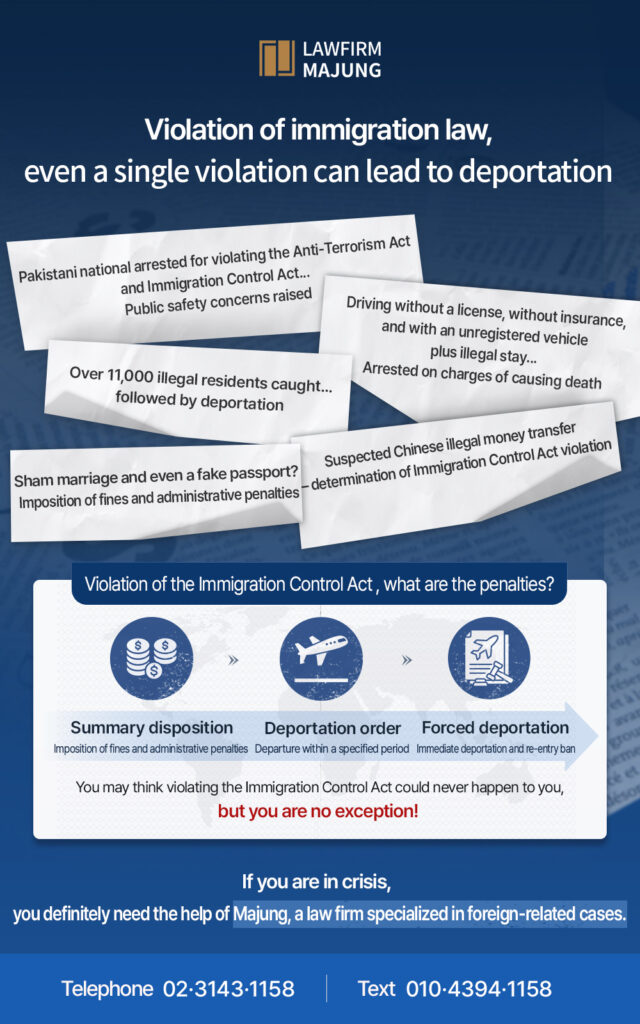
3. Detained at an Immigration Facility? Consider Temporary Release and Deportation Defense Together
Some foreign nationals facing deportation are detained at an immigration detention facility following an investigation.
In particular, if you have already received a deportation order and are waiting for removal from Korea, it may become difficult to prepare your legal response while living outside the detention facility.
|
In these circumstances, it is important to distinguish between challenging the deportation order itself and addressing your current detention status. |
|---|
|
First, identify the legal basis for your current detention. |
|
Second, consider whether temporary release from immigration detention is possible. |
|
Third, review detention-related applications separately fromobjections to the deportation order. |
|
Fourth, identify documents that family members or legal representatives can obtain. |
However, the documents required are not necessarily identical in every case.
The important point is to identify which administrative decision is being challenged and what facts must be established in the relevant procedure.
As such, cases involving forced deportation require a comprehensive review of the legality of the deportation order, the individual's detention status, and the possibility of actual removal from Korea.
The Korea Immigration Service may be involved in several different procedures, so understanding the current stage of the case is essential when determining the appropriate response.
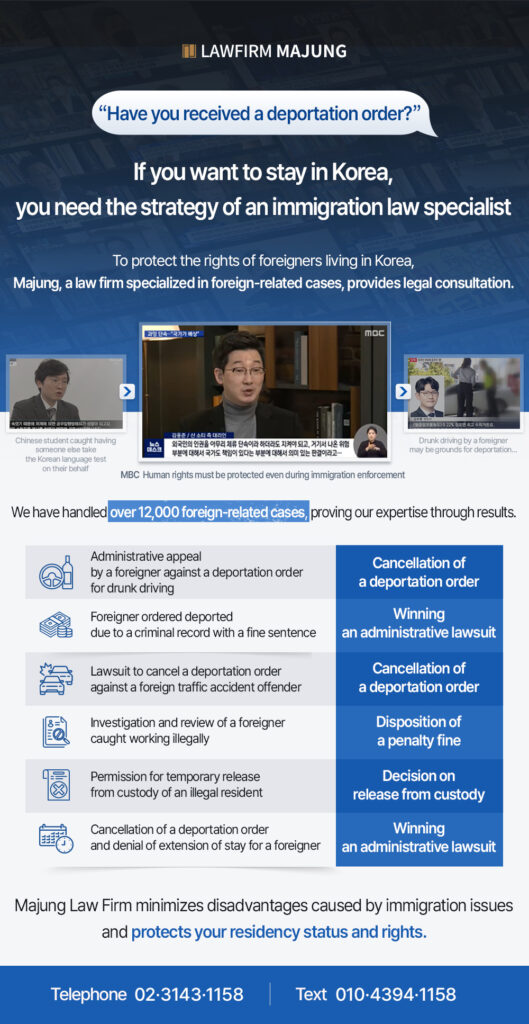
If you receive a deportation order in Korea, the first thing you should examine is the legal basis and specific contents of the decision.
You should also remember that the statutory objection period is short, making an early response particularly important.
Majung Law Firm reviews legal issues involving criminal cases involving foreign nationals and immigration-related administrative measures together, seeking appropriate responses based on the current stage of each case.
For foreign nationals who have received deportation orders, it is particularly important to examine the legal grounds for the decision, the actual circumstances of the case, and their current situation in Korea.
If a criminal case has resulted in immigration-related problems, reviewing both the criminal outcome and the legal basis for the deportation order is also essential.
If you are looking for a Korea immigration service specialist or a lawyer experienced in immigration matters, make sure to check whether they can assist not only with challenging deportation orders but also with detention-related procedures and administrative litigation.
Early legal review and preparation can help you understand the available options and reduce unnecessary risks throughout the immigration process.
Check out our success case regarding forced deportation and immigration disputes: Administrative Lawsuit to Respond to Forced Deportation Order for Illegal Immigrant / Minimization of Re-entry Ban Period
Multilingual consultation available in English and Chinese.
Professional interpreters assist from the first consultation to the conclusion of the case.
Offices in Seoul, Daejeon, Busan, Daegu, and Gwangju
Don’t face the legal system alone. Let Majung fight for you!