If one spouse holds a foreign nationality, or if the couple has lived abroad, the first step is to determine which country’s laws will apply.
Without this, the next stages of the process cannot proceed properly.
In general, if both spouses share the same nationality, the family law of that country applies. If they hold different nationalities, the law of the country where they last lived together is usually applied.
However, if neither of these conditions is clear, the law of the country most closely connected to the case will be chosen.
In practice, when a spouse residing in Korea files for divorce, Korean civil law often applies—but not in every situation.
① Mutual Agreement
When both spouses agree to end the marriage, and certain requirements are met, the divorce can be finalized relatively simply through the family court. However, if one spouse resides overseas or does not fully understand the Korean-language documents, the process can be delayed or even fail.
If the couple has minor children, a detailed agreement must be submitted to the court regarding custody, visitation rights, and child support obligations.
If the spouses cannot reach a consensus on these issues, the matter will inevitably move to litigation.
② Litigation
Litigation becomes necessary when mutual agreement is not possible, or when there is no communication at all between the spouses.
In this case, clear legal grounds for divorce must be established under civil law, such as adultery, abuse, abandonment, or prolonged conflict showing that the marriage cannot realistically continue.
In international divorce cases, one of the biggest challenges is that the other spouse’s registered address is often abroad.
Serving court documents can be more complicated than the trial itself.
3. Can a Foreign Spouse Maintain Their Visa Status After Divorce?
For foreign spouses preparing for an international divorce in Korea, one of the biggest concerns is whether they can continue to stay in Korea even after the legal relationship with their spouse has ended.
This issue is especially important because the F-6 visa is based on marriage, meaning its validity is re-examined once the marriage is dissolved.
Divorce does not automatically cancel the F-6 visa. The immigration office considers various factors, such as the circumstances of the divorce and whether the foreign spouse is actually raising children in Korea, before deciding on an extension.
The review process is far from simple. Applicants must provide objective documentation proving ongoing family ties, such as:
For F-6-3 cases, where the foreign spouse is not at fault, additional documentation such as death certificates, missing person reports, police investigation records, or domestic violence statements must be submitted.
Without sufficient supporting evidence, visa extension applications are often denied.
If residency issues are not reviewed alongside the divorce process from the beginning, the legal proceedings may conclude, but the foreign spouse may still lose the right to remain in Korea.
4. In International Divorce, the First Direction You Take Determines the Outcome
As mentioned earlier, the international divorce process is not simply a matter of submitting paperwork.
Because multiple issues—such as service of documents, applicable law, child custody, and visa status—are all interconnected, failing to identify the right starting point can result in the entire process stalling.
In particular, if the other spouse is abroad or out of contact, the case must proceed through public notice service, which significantly slows down the timeline.
Moreover, if the wrong applicable law is chosen, the marriage may be legally dissolved, but rights regarding children or property may not be properly protected.
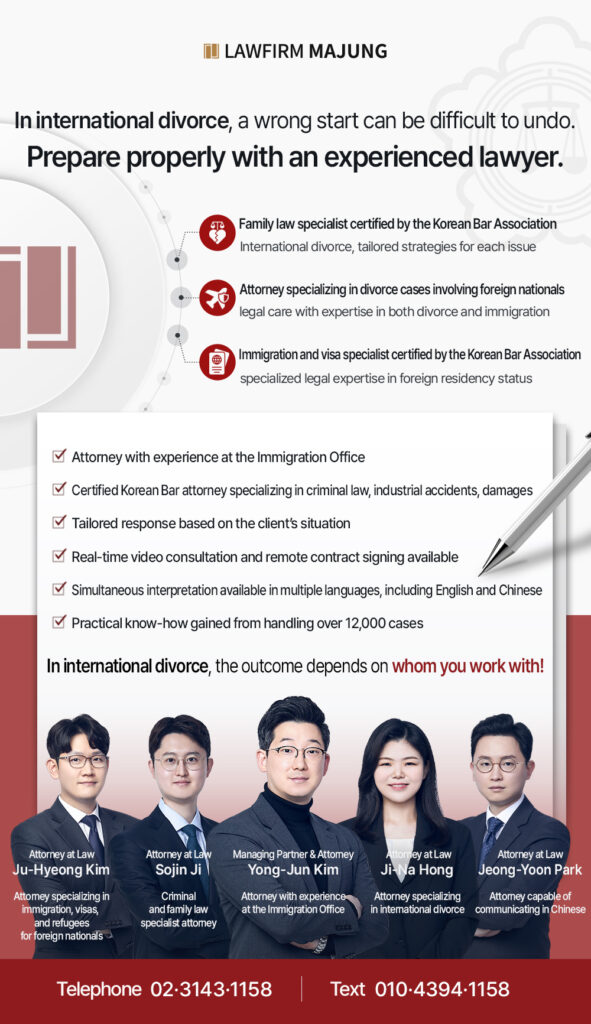
Our team of family law, immigration, and visa specialists focuses on international divorce cases.
If you encounter obstacles during preparation, having your documents and procedural direction reviewed accurately at the early stage can serve as the key starting point for managing the entire process effectively.
Multilingual consultation available in English and Chinese.
Professional interpreters assist from the first consultation to the conclusion of the case.
Offices in Seoul, Daejeon, Busan, Daegu, and Gwangju.
Don’t face the legal system alone. Let Majung fight for you!