
1. After a Sex Crime Disposition, a Separate Immigration Review Begins
In cases where a foreigner accused of sexual misconduct receives a fine or a suspension of indictment, the problem does not end with the conclusion of the criminal process. The record is transmitted to the Immigration Office within a certain period, after which a separate immigration disciplinary review may begin. This review does not rely solely on the amount of the fine or the severity of the sentence. Instead, immigration authorities comprehensively consider factors such as:
- The nature of the offense,
- The need to protect the victim,
- The possibility of reoffending, and
- The stability of the foreigner’s living base in Korea, such as family ties or employment.
For example, if the victim was a minor or the incident occurred in a public setting, these circumstances alone may be considered aggravating factors. Conversely, even if the case ended with a suspension of indictment and no imprisonment, it may still be classified as a sex crime record, prompting a re-evaluation of visa eligibility. If a negative decision is made during this process, the foreigner may face visa extension denial or even a departure order, regardless of the current visa’s validity period. Therefore, for foreigners facing sexual offense allegations, a response focused only on the criminal case is not enough. To improve the chances of maintaining legal stay, it is essential to plan both the criminal defense and immigration response from the very beginning.
2. Key Factors That Determine Visa Eligibility in the Immigration Disciplinary Review
The immigration disciplinary review does not determine visa eligibility solely based on the amount of the fine or whether a suspension of indictment was granted. In cases involving foreigners accused of indecent assault, which are considered socially sensitive offenses in Korea, immigration authorities conduct a broader evaluation focused on one key question: “Is this person still qualified to remain in Korea?” The following factors are typically considered during the review:
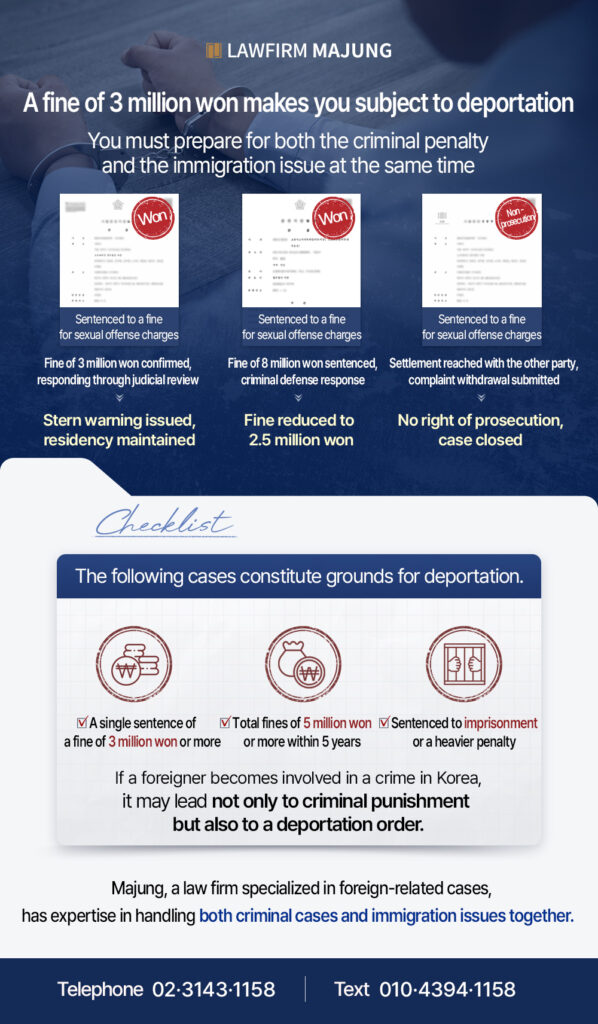
If even some of these factors are not met, the decision can still be unfavorable — even if the criminal punishment was minor. In particular, if the fine exceeds 3 million KRW or if the prosecutor’s record mentions a possibility of reoffending when the case was suspended from indictment, the likelihood of a negative outcome in the review becomes significantly higher.
3. Simple Explanations Won’t Protect Your Visa Status
e of the most common mistakes made by foreign suspects is trying to resolve the situation by simply saying, “I had no intent,” or “It was a misunderstanding.” However, in foreign indecent assault cases, such explanations can actually work against them—not only in the criminal process, but also during the immigration disciplinary review. If the initial statement is unclear or supporting evidence is insufficient, unfavorable facts may remain in the investigation record. These records are often used by immigration authorities as grounds to determine that the person is unfit to stay in Korea. If the response is delayed, the case may end without a settlement with the victim, or without submitting a letter of remorse or statement, and without reflecting any evidence of social contribution or education history—all of which can lead to visa extension denial. Even if the case ends with a fine or suspension of indictment, the Immigration Office may still treat it not as a minor punishment but as a sex crime record that negatively affects the person’s visa eligibility. Therefore, to protect one’s right to stay in Korea, it is crucial not to rely on simple explanations but to take a strategic and coordinated approach from the beginning—addressing both criminal defense and immigration procedures simultaneously.
4. Response Strategies in Foreign Indecent Assault Cases — Real Case Examples
Mr. B, a Nepalese national, was working at a major corporate research center in Korea under an E-7 visa. The incident occurred during a night shift in the company break room. While joking with a coworker he was friendly with, Mr. B lightly tapped her on the back — an act that led to indecent assault charges against a foreigner. Based on the victim’s statement and witness testimony, the charges were upheld. The prosecutor sought a fine of 4 million KRW, and the court concluded the case through a summary order. However, immediately after the summary order was finalized, Mr. B received a summons for an immigration disciplinary review, where he was informed that his visa extension could be affected, prompting him to take action. Following his attorney’s advice, Mr. B prepared a detailed written statement explaining the circumstances of the incident, along with a settlement agreement with the victim and a letter of remorse. He also submitted proof of his child’s school enrollment, family residence status, and completion of a sexual awareness education program to the immigration office. This proactive response had a positive effect on the review, and the authorities ultimately approved his visa extension on a conditional basis.