
“I thought everything was resolved with a fine, but then I suddenly received a call from immigration.”
In many cases, what initially seems like a simple matter can later develop into an issue affecting residency status.
In particular, after the criminal procedure has been completed, a separate assessment may be conducted at the immigration stage, leading to unexpected outcomes.
This situation is not simply due to the complexity of the process.
Because criminal penalties and immigration decisions are interconnected, the initial response can significantly influence the final result.
In fact, even in similar cases, some may pass without issue, while others may lead to a departure order.
1. How Criminal Penalties Can Expand Into Immigration Issues
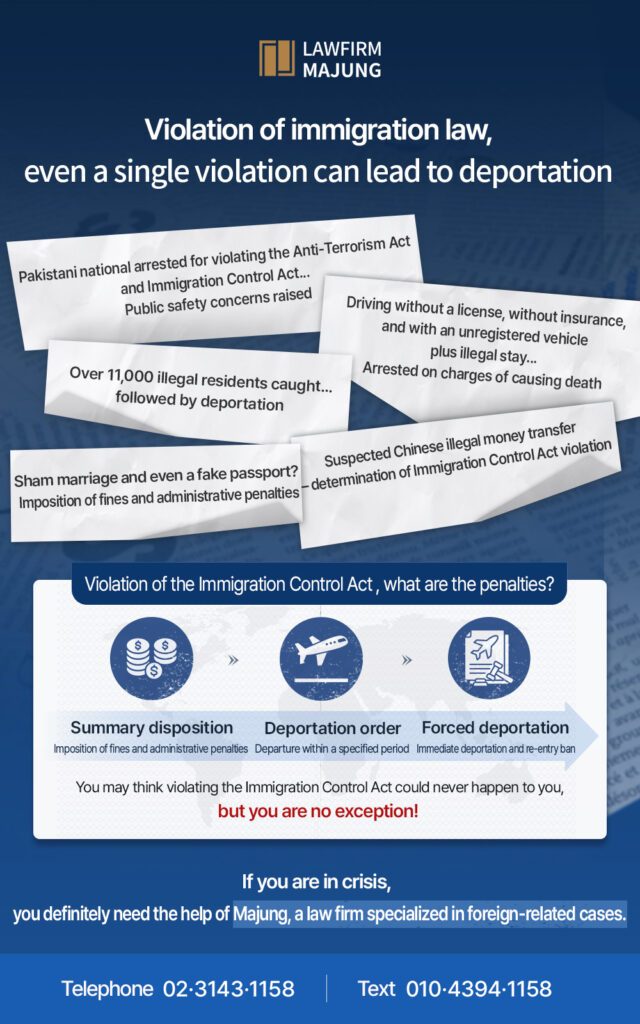
Many people who seek an immigration lawyer find themselves facing difficulties again with issues they believed were already resolved.
For example, in cases where a person receives a fine for a minor assault or a DUI-related offense, the matter may appear to be concluded from a criminal law perspective.
However, immigration authorities assess the situation differently.
Rather than focusing on the fine itself, they consider it as a record of violation of legal order, they review whether the individual has lived in a manner consistent with the purpose of their stay.
They also consider the likelihood of similar conduct occurring in the future.
In this way, the criminal outcome is not the end, but rather becomes a standard for immigration review.
Ultimately, even in the same case, the ability to maintain residency may vary depending on how the situation is handled afterward with the help of attorneys.
2. How Decisions on Departure Orders Vary
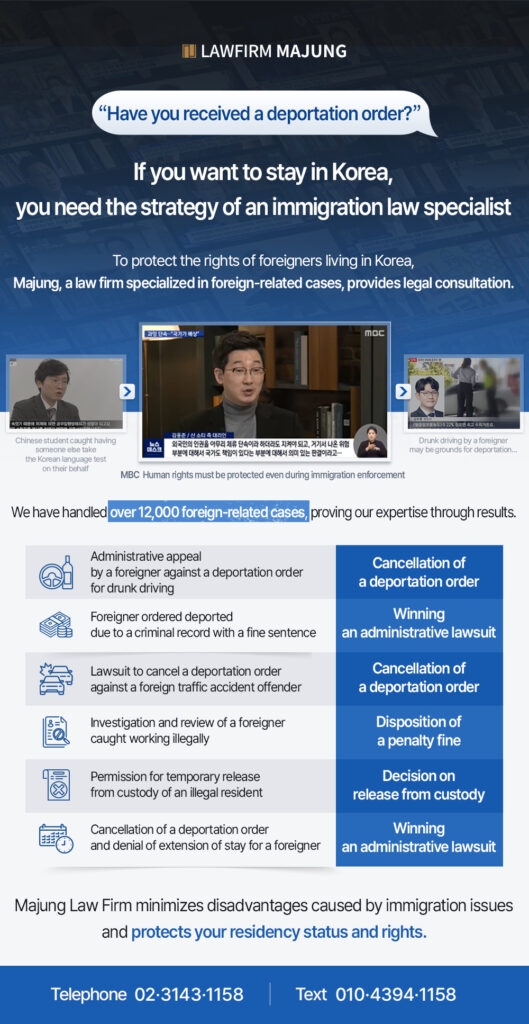
One of the most common measures encountered through immigration lawyers is a departure order.
Although it is less severe than deportation, it still has a significant impact on residency, as it requires leaving the country within a specified period.
An important point is that a departure order is not determined solely by the outcome of the case.
For example, even in cases involving the same fine:
In this way, the outcome depends not only on the case itself, but also on how it is explained and handled afterward with South Korean lawyer.
3. Can You Feel Safe After a Suspension of Prosecution?
One of the most common misunderstandings among those seeking an immigration lawyer concerns a suspension of prosecution.
Although it means that no criminal punishment is imposed, it can be interpreted very differently in the immigration context.
A suspension of prosecution acknowledges that a violation occurred but defers punishment.
As a result, in the immigration stage, it may be considered in terms of:
① Doubts about compliance with legal order
② The likelihood of repeating similar conduct
③ The appropriateness of maintaining residency status
In other words, a suspension of prosecution is not a “closed case,” but rather becomes material for reassessment in immigration review.
For this reason, it is important to consider the potential immigration impact from the criminal stage onward.
4. Why Initial Response Changes the Outcome
The reason outcomes can differ significantly depending on when an immigration lawyer becomes involved is that the direction of the case is often determined at an early stage.
In cases where there is no proper initial response:
On the other hand, when the response is structured from the beginning with immigration considerations in mind:
Ultimately, even in the same case, the outcome can vary depending on how it is handled.
5. Why Criminal and Immigration Issues Must Be Considered Together
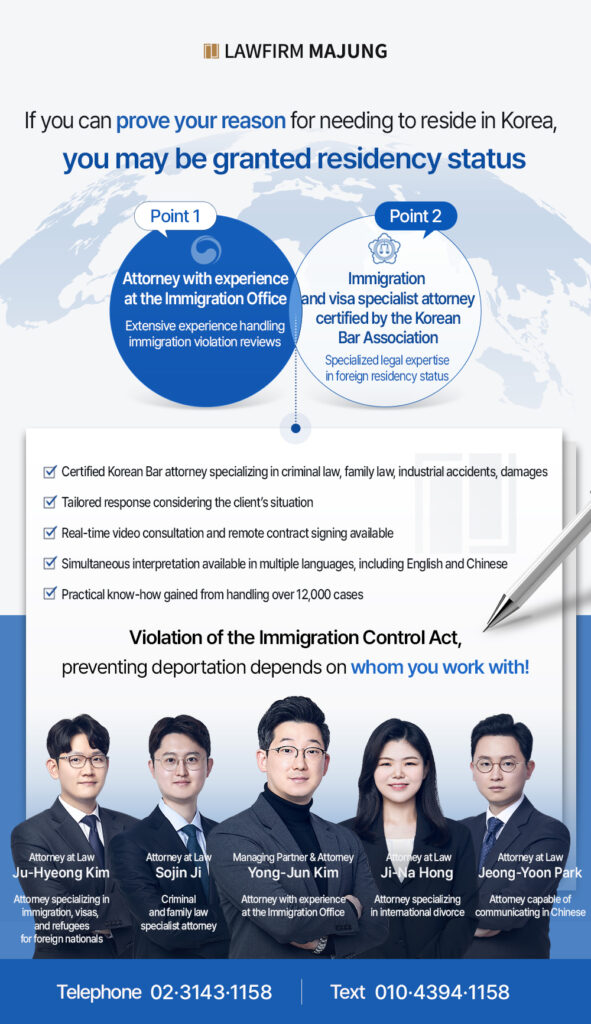
The key role of an immigration lawyer is to view criminal procedures and immigration procedures not as separate matters, but as a single, connected process.
Even if a case appears minor from a criminal law perspective, it may still be considered grounds for unsuitability of stay in the immigration context.
Therefore, the following factors must be considered together:
Only when these three elements are addressed simultaneously can a relatively minor case be prevented from escalating into an immigration issue.
Ultimately, the role of an immigration lawyer in Korea is not simply to resolve the case, but to design a strategy that allows the individual to maintain their residency and to protect your rights.
These factors go beyond simply providing information—they play a crucial role in influencing the actual outcome.
If you are currently facing such concerns, it is recommended that you seek assistance from a legal professional.
Offices in Seoul, Daejeon, Busan, Daegu, and Gwangju
Don’t face the legal system alone. Let Majung fight for you!