
Recently, there has been a steady increase in inquiries related to repeat theft cases involving foreign nationals, particularly in places such as convenience stores, supermarkets, and unmanned shops.
Many individuals initially treat these as minor theft cases and respond lightly, but there are numerous instances where they end up facing not only criminal penalties but also immigration-related consequences at the same time.
In particular, for foreign nationals, once repeat offending is recognized, the issue does not end with a simple fine.
After the criminal process, it may also lead to a review by immigration authorities, making the direction of the initial response extremely important.
Today, we will explain the key points many people are concerned about, including the possibility of settlement, the actual effect of a non-punishment agreement, the criteria for sentence mitigation, and the immigration considerations that must also be taken into account.
Contents
1. In Repeat Theft Cases Involving Foreign Nationals, How Is “Repeat Offending” Determined?
The most important issue in this type of case is whether “repeat offending” is recognized.
Repeat theft is not determined simply by the number of incidents.
Investigative authorities consider multiple factors, including:
In other words, even small-value thefts can be classified as repeat theft if they occur repeatedly.
Once repeat offending is recognized at this stage, the case is no longer treated as simple theft, and it becomes much more difficult to obtain sentence mitigation.
2. What Does a “Settlement” Mean in Repeat Theft Cases Involving Foreign Nationals?
In repeat theft cases, one of the first things many people consider is reaching a settlement.
A settlement is certainly an important factor, but it is not a complete solution.
For a settlement to be meaningful, the following conditions are important:
At this stage, a key document that is often prepared together is a non-punishment agreement.
However, in repeat theft cases, the matter is often not resolved solely by submitting a non-punishment agreement.
3. When a Non-Punishment Agreement Does Not Lead to Sentence Mitigation
There are actual cases where, even after a non-punishment agreement has been submitted, a prison sentence or a suspended sentence is still imposed.
The reasons include:
In other words, the formula “non-punishment agreement = sentence mitigation” does not always apply.
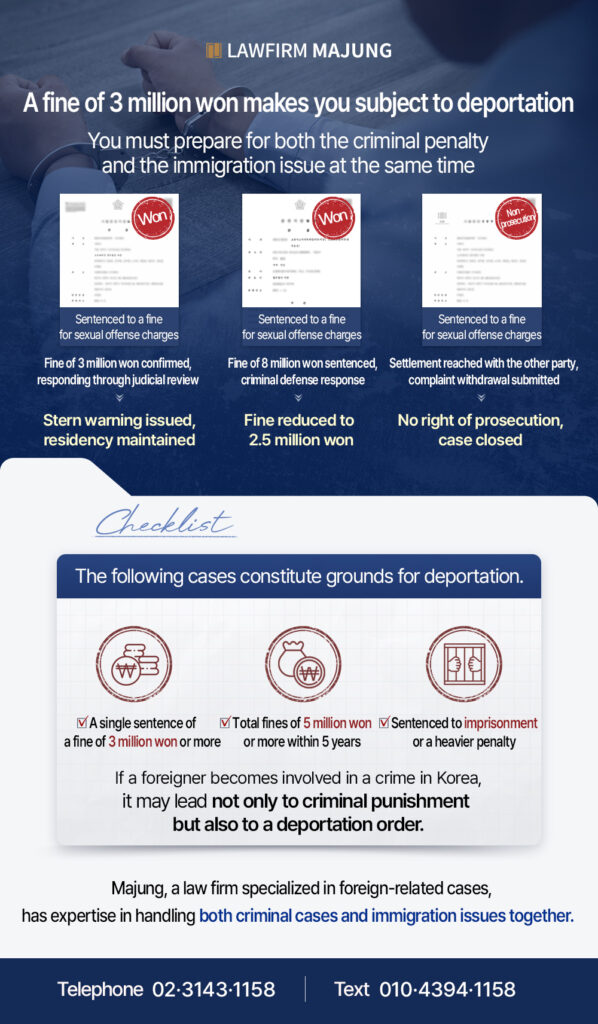
In repeat theft cases, both criminal judgment and immigration considerations are assessed at the same time.

4. Sentence Mitigation in Repeat Theft Cases Involving Foreign Nationals: Is It Actually Possible?
Then, when is sentence mitigation possible in repeat theft cases?
In practice, the following points are important:
Only when all of these factors are aligned does the possibility of sentence mitigation open up.
In particular, the direction of the initial response plays a decisive role in the outcome of the case.
Another aspect that is often overlooked in repeat theft cases involving foreign nationals is immigration response.
Even if the criminal trial is concluded, it does not guarantee continued residency or automatic visa extension.
Therefore, focusing only on sentence mitigation is not sufficient.
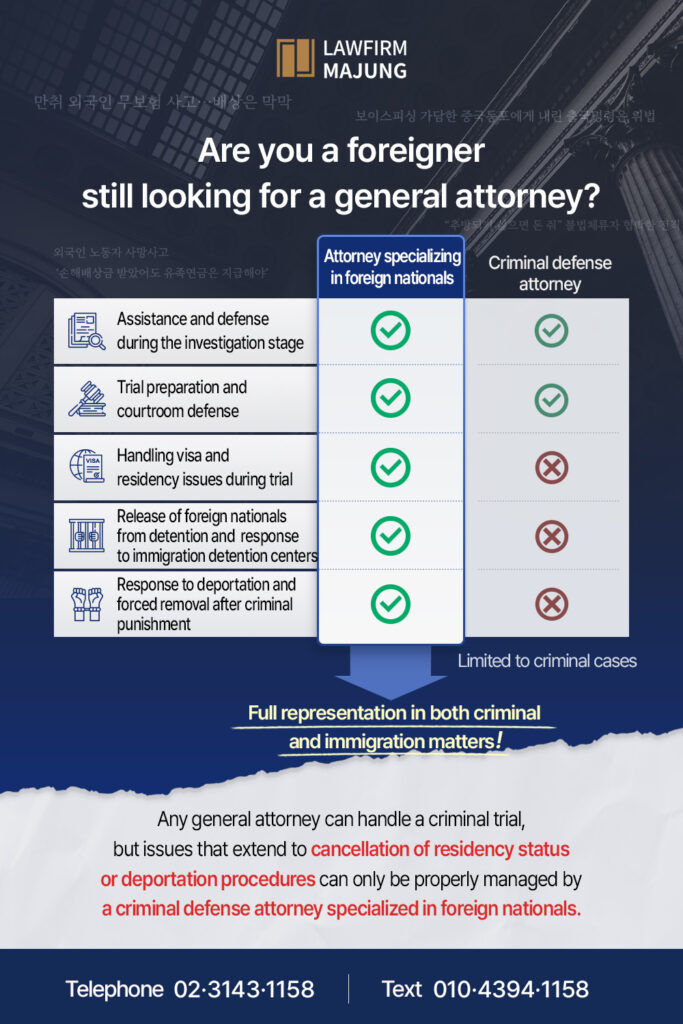
It is essential to establish a strategy with a Korean lawyer that addresses both the criminal case and immigration procedures simultaneously.
5. Why an Integrated Response Is Necessary in Repeat Theft Cases Involving Foreign Nationals
Repeat theft cases involving foreign nationals are both criminal matters and cases that carry the risk of administrative (immigration) consequences.
For this reason, the following approach is necessary:
If these steps are handled separately rather than in an integrated manner, the overall risk can increase.
6. Repeat Theft Cases Involving Foreign Nationals Are Different from Simple Theft Cases
At Majung Law Firm, we approach these cases with this understanding.
This type of case is not one that simply “ends with a settlement” or is “resolved with a fine.”
A single decision at the early stage can influence sentence mitigation, immigration outcomes, and even your ability to remain in Korea.
If you are facing issues related to repeat theft as a foreign national, it is advisable to seek solutions with a legal representative who can address both criminal and immigration aspects together.
Multilingual consultation available in English and Chinese.
Professional interpreters assist from the first consultation to the conclusion of the case.
Offices in Seoul, Daejeon, Busan, Daegu, and Gwangju
Don’t face the legal system alone. Let Majung fight for you!