
Which law firm in Korea could help me with my sexual assault allegations?
“I didn’t think it would become this serious.” — this is a phrase often heard in cases involving sexual misconduct by foreign nationals.
What may seem like a casual remark or light physical contact can be interpreted as a sexual offense in Korea,
and there are real cases where individuals are reported for sexual misconduct regardless of their original intent.
In particular,
differences in language interpretation and cultural perception
make it crucial to establish a response strategy from the early stages—
especially one aimed at preventing a lasting record
—to protect residency status.
It is easy to assume that the matter ends with a simple fine,
but in reality,
once a criminal record is created, it can directly impact immigration status.
There are many cases where visa applications are denied or departure orders are suddenly issued afterward.
If the situation is not handled properly from the beginning,
the process can become more complicated,
and the consequences may extend beyond the individual—
affecting the stability of their entire family.
Because these issues cannot be resolved through criminal procedures alone,
securing both a minimized criminal record and stable living conditions requires
a strategic legal approach with professional assistance.
Contents
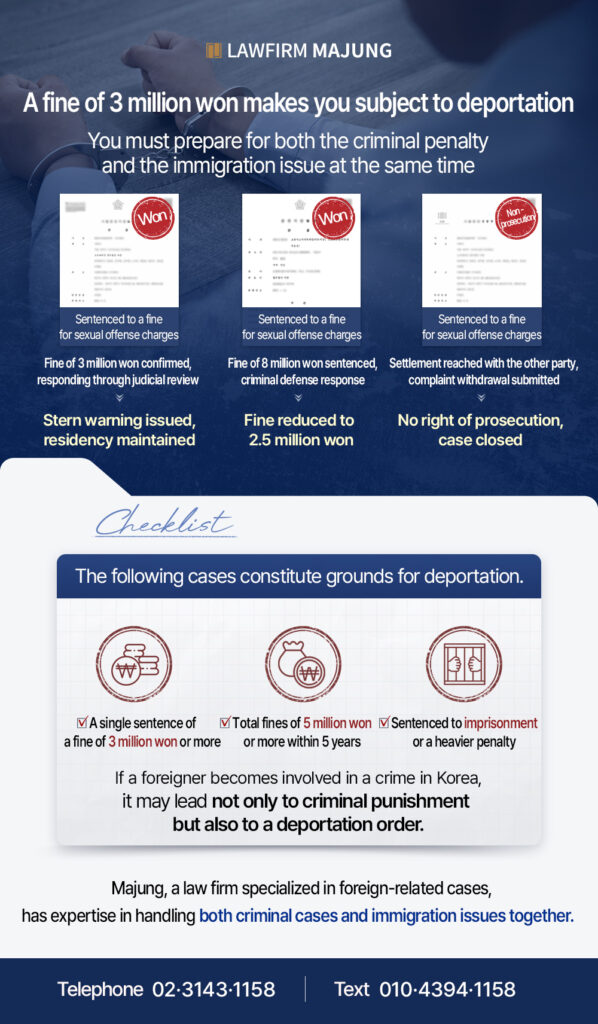
1. Sex Offense Case: A Deportation Crisis Triggered by a Single Fine (Real Case)
The client, a British national, had completed both a master’s and Ph.D. program in Korea and was working full-time at a research institute within a mid-sized company.
He maintained his residency status through marriage to a Korean spouse, and both of his children were born in Korea, forming a stable living foundation.
However, a physical interaction that occurred in a private setting was interpreted as causing sexual discomfort, leading to charges of sexual molestation.
The case was classified as a sex offense, and he was sentenced to a
fine of 4 million KRW.
As a result, a criminal record was created, and the immigration office later notified him of possible
visa extension denial and deportation,
placing his entire family in crisis.
With the assistance of legal counsel, the client responded to the administrative review, focusing on the following key points:
He also voluntarily completed preventive education to avoid reoffending.
He was the sole provider for his spouse and two children, and his second child required ongoing medical treatment.
After reviewing these factors—including his remorse, family dependency, and social contributions—the immigration authorities decided to issue a
“strict warning” instead of deportation.
As a result, the client was able to continue living in Korea, and his family’s daily life remained stable.
2. Even After Criminal Proceedings End, Immigration Issues May Just Begin
Many foreign nationals who receive a fine for sexual misconduct or similar offenses believe that once the sentence is finalized, the matter is over.
However,
in Korea, immigration administration operates entirely separately from criminal judgments.
The decision on whether a person can continue to stay is reassessed based on completely different standards.
A key issue is the timing gap between these two processes.
After the criminal penalty, there may be no immediate notice,
but months later—often during visa renewal—
an unexpected denial can occur without prior warning.
Immigration authorities evaluate eligibility to remain based on factors such as:
3. Foreign National Sexual Misconduct: The Real Risk Begins Once a Record Is Created
“Isn’t it okay if it’s just a summary order without a formal trial?” — this is a question often asked in sexual offense cases.
However,
in immigration practice, the key issue is not the type of disposition, but whether a criminal record remains.
Regardless of how the case is resolved,
if a record of a sexual offense is left in administrative records,
it can lead to disadvantages during immigration review.
The following are key factors actually considered in evaluation:
Even if the criminal penalty is relatively light,
the moment a record exists,
immigration authorities may determine that the individual is not eligible to remain.
There are many cases where individuals underestimated the situation—thinking it was a minor matter because it ended with a fine or suspension of prosecution—
only to later face visa denial or deportation.
Ultimately,
in cases involving sexual misconduct by foreign nationals,
what matters most is not just the punishment itself,
but how that outcome is recorded in the administrative system.