
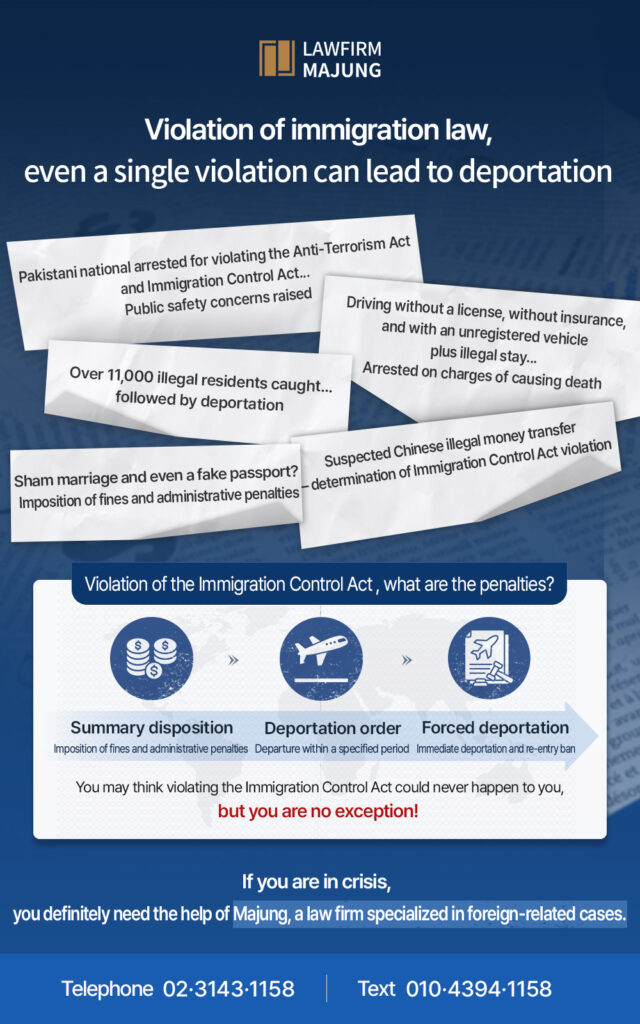
In recent years, immigration enforcement and administrative sanctions against foreign nationals have become noticeably stricter. In particular, when a case is intertwined with a criminal offense, it has become increasingly common that one cannot feel reassured simply because the matter ended with a fine. In fact, there are consistent cases in which, after criminal punishment, the immigration office makes a separate determination and issues a departure order or imposes restrictions on stay. As such, violations of the Immigration Control Act are not merely minor legal infractions—they can escalate into serious issues that directly determine whether a person can continue residing in the country.
1. What is a violation of the Immigration Control Act?
A violation of the Immigration Control Act refers to a failure to comply with the legal obligations imposed on foreign nationals throughout the entire process of entry, stay, and departure. This includes not only illegal stay, but also a wide range of situations such as prior criminal records, false reporting, and engaging in activities outside the permitted scope of one’s visa status, all of which can become grounds for violations. In particular, a common misunderstanding among many foreign nationals is the belief that “since the criminal punishment is over, the immigration issue must be over as well.” In reality, however, criminal procedures and immigration procedures operate under completely separate decision-making frameworks.
2. In what situations can a violation of the Immigration Control Act occur?
In practice, the following are representative situations that often lead to a determination of a violation of the Immigration Control Act:
At this stage, the immigration office focuses its assessment on one central question: “Is it appropriate for this foreign national to continue residing in the Republic of Korea?”
3. Why can a departure order be issued even when the penalty is only a fine?
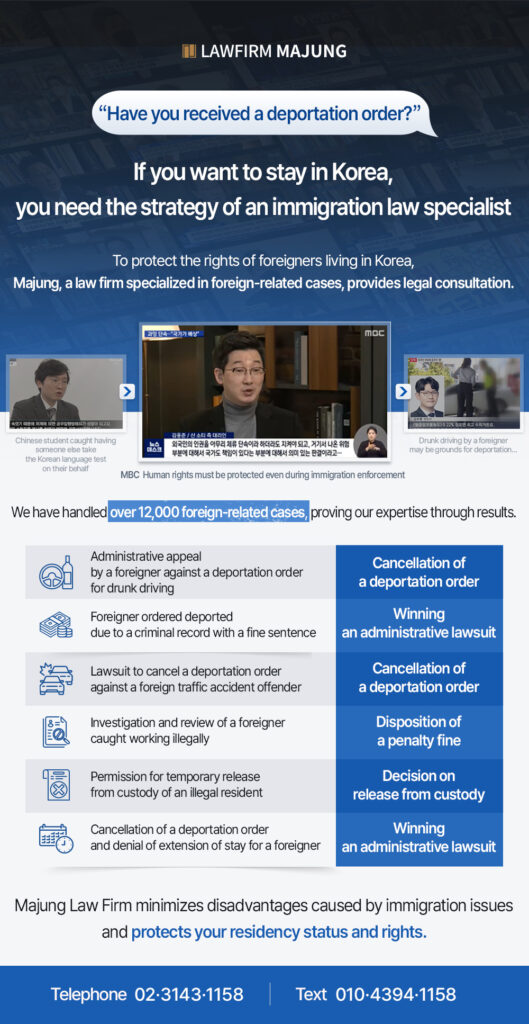
This is the point that many people find most confusing. In reality, there are numerous cases in which a departure order is issued even though the person received only a fine in the criminal case. The reason is that a departure order is not a criminal punishment, but an administrative measure. In other words, the key standard is not the severity of the criminal penalty, but rather an assessment of whether the individual is suitable to continue staying in the country. In this process, factors such as a person’s family relationships, length of stay, and level of social integration are often not sufficiently taken into consideration.
4. A successful case of canceling a departure order after a fine-based criminal conviction
nt was a Chinese national who had lived in the Republic of Korea for a long period, continuing work related to the broadcasting industry. He was married to a Korean national and had established a family and daily life in Korea. However, after being sentenced to a fine of 5 million KRW for an offense involving obscene communications using telecommunication media, and separately a fine of 300,000 KRW for a violation of the Road Traffic Act, the client received a departure order from the immigration office. Because an administrative appeal had already been dismissed, the client was facing an imminent risk of forced departure. In particular, the possibility of being separated from his spouse—who was pregnant and approaching childbirth—had become a very real and urgent concern.
The court found that the immigration office’s decision involved an abuse and deviation of discretionary authority, and ultimately revoked the departure order. As a result, the client was able to escape the risk of forced departure and continue a stable life in Korea together with his family.
5. What is the most important point when responding to an Immigration Control Act violation?
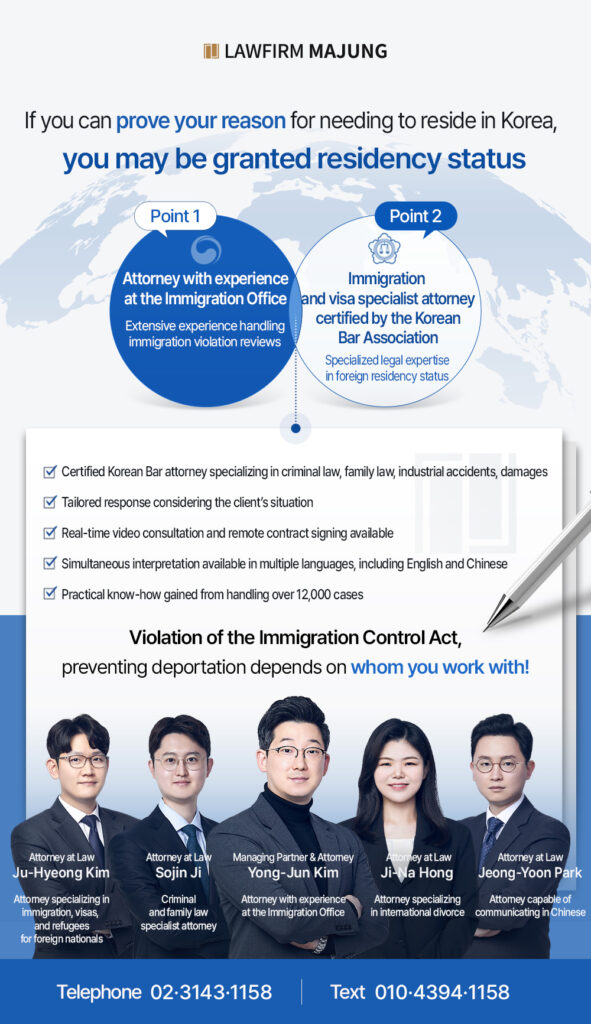
In cases involving violations of the Immigration Control Act, the most important factor is when and in what direction you respond. Rather than waiting until a departure order has already been issued, a strategic response that considers immigration risks from the criminal stage onward is essential. In particular, even after an administrative appeal has been dismissed, if there is sufficient ground to contest the decision through an administrative lawsuit, the outcome can vary greatly depending on how well the initial materials are organized and the legal arguments are structured. Immigration matters are difficult to resolve with fragmented legal knowledge alone. Law Firm Majung approaches Immigration Control Act violation cases from multiple angles, based on the following strengths:
Violations of the Immigration Control Act are not merely legal issues—they involve one’s home, family, and future. Even in similar circumstances, the outcome can differ completely depending on who handles the case and how it is handled. Rather than facing this alone, we strongly recommend resolving the matter together with a qualified legal representative. Multilingual consultation available in English and Chinese. Professional interpreters assist from the first consultation to the conclusion of the case. Offices in Seoul, Daejeon, Busan, Daegu, and Gwangju Don’t face the legal system alone. Let Majung fight for you!