
Hello, this is Majung Law Firm, specializing in legal services for foreign nationals.
Deportation is difficult to reverse once it has been issued.
It is not uncommon to hear from people who thought they were safe because they had not been caught, only to suddenly receive a notice from immigration authorities one day.
Did you think avoiding enforcement was enough?
Recently, immigration authorities have been identifying violations through entry/exit records, administrative data, and even reports from residents.
As a result, departure orders or deportation notices can be issued without prior warning.
The issue is that even minor problems—such as incomplete documents or overstaying—can lead to long-term entry bans.
In this way, deportation applies more broadly than many expect, and once imposed, it can result in long-lasting disadvantages.
Because deportation cases can be difficult to handle alone, it is advisable to seek assistance from a legal professional if you are unsure how to proceed.
1. Deportation Cases Often Begin in This Situation
If you think you’re safe just because you haven’t been caught, it may be too early to feel reassured.
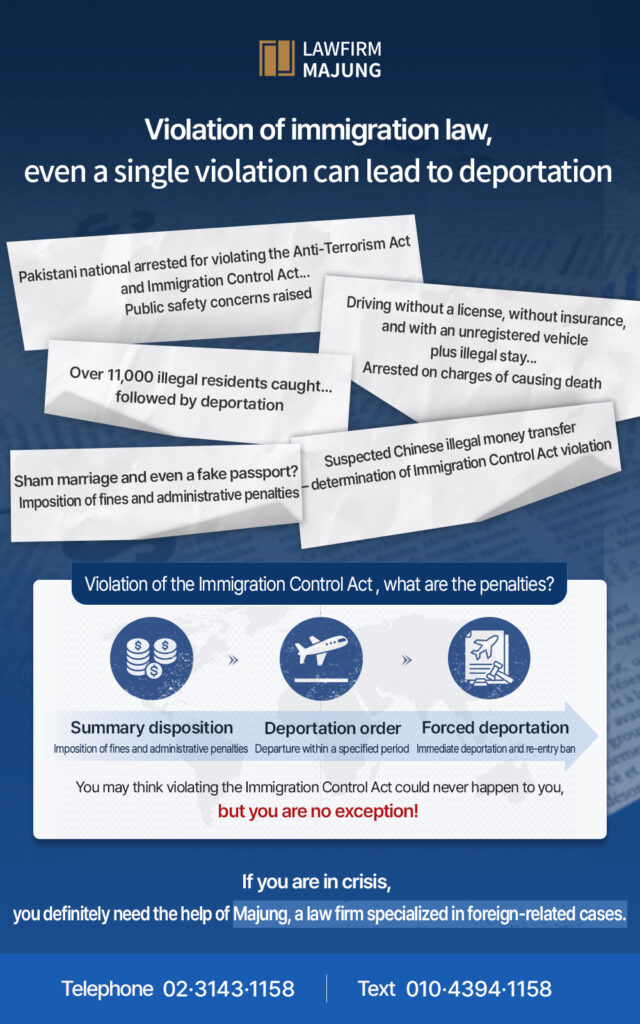
The most common reason for deportation is illegal stay (overstaying a visa).
This includes situations where a person remains in Korea after their visa has expired or continues to stay after losing their legal status.
Recently, with integrated administrative systems, violations are increasingly being detected without direct enforcement actions.
In addition, factors such as obtaining employment authorization through false information, changing workplaces without permission, or having a criminal record can also lead to deportation.
In particular, in cases of illegal stay, departure orders are often issued immediately without much opportunity for explanation.
The real issue is not just being detected, but the long-term disadvantages that remain afterward.
2. Receiving a Deportation Notice Doesn’t Mean You Must Leave Immediately
Rather than focusing only on the decision itself, it is important to identify what actions can be taken at this stage.
If a deportation decision has been issued, you may consider the following responses:
Reasons such as how the enforcement occurred, documentation mistakes, or health conditions may be used.
The choices you make now can directly affect your ability to stay or return in the future.
3. Real Case: How a U.S. National Protected Family Livelihood After a Deportation Order
① Background and Initial Situation
Mr. A, a U.S. national, had previously been penalized for a criminal case in Korea and was later issued a departure order by immigration authorities.
He initiated procedures to request the cancellation of the departure order and remained in Korea while awaiting the result.
However, as time passed without separately applying for a stay of execution, the departure deadline expired.
As a result, Mr. A was classified as an overstayer and was subsequently issued a deportation order.
At the time, his spouse and young child were living with him in Korea, making the situation not just a matter of returning home, but one directly affecting his family’s livelihood.
② Key Issues and Response Strategy
Mr. A promptly filed an administrative lawsuit challenging the validity of the deportation order and simultaneously requested a stay of execution to prevent enforcement of the order until a final court decision was made.
As a result, the court granted a suspension of the deportation order, allowing him to remain in Korea until the conclusion of the case.
During the proceedings, the focus was placed on Mr. A’s family structure and the background of his stay:
These factors were presented not as a simple procedural violation, but as a case involving humanitarian considerations, including the potential breakup of a family.
Additionally, it was argued that the deportation order lacked sufficient detail in its stated reasons and relied on only formal references to legal provisions, raising concerns about procedural defects.
This was framed as a violation of the administrative law requirement to clearly state the grounds for a decision.
Although the authorities maintained that Mr. A’s failure to comply with the departure order justified the consequences, once formal legal action was initiated, they began to consider the possibility of a practical resolution.
Eventually, the authorities initiated negotiations and proposed resolving the matter under certain conditions.
Accordingly, the administrative lawsuit was withdrawn, and the case was concluded without unnecessary enforcement measures.
This case demonstrates that even after a deportation order is issued, there may still be room for strategic legal response and negotiation to achieve a more favorable outcome.
4. Waiting Until the Departure Deadline May Cost You the Chance to Return to Korea for Years
A deportation decision for a foreign national does not simply mean “you must leave.”
Once the decision is finalized and the deadline passes, it can lead to long-term consequences, such as being unable to re-enter Korea for several years or having future visa applications denied altogether.
In particular, if you let the deadline pass without taking any action, you may lose the opportunity to negotiate or coordinate with the authorities.
If you are currently in an overstaying situation, this is the point where you need to clearly assess your remaining options and realistically evaluate possible responses.
It is helpful to review whether any procedures are currently in progress and what circumstances can be supported with evidence.
If it is difficult to resolve your residency issue on your own, or if you want to organize your deportation-related situation in a structured way, it is advisable to seek assistance from a legal representative.
Professional interpreters assist from the first consultation to the conclusion of the case.
Don’t face the legal system alone.
Let Majung fight for you!