
For foreign nationals living in Korea, the Immigration Act is more than just a set of regulations—it is a fundamental legal framework that directly affects the stability of their immigration status.
Unexpected situations may arise in everyday life that result in violations of the Immigration Act, and these issues often have consequences that are far more serious than many people expect.
In many cases, what initially appears to be a minor violation can ultimately affect a person's immigration status and even lead to deportation. Recently, we have continued to receive inquiries from foreign workers, international students, overseas Koreans, and other foreign nationals seeking advice from immigration lawyers regarding immigration-related issues.
1. What Is the Immigration Act?
The Immigration Act governs every stage of a foreign national's stay in Korea, from entry and residence to departure. Violations of the Immigration Act are broader than many people realize.
Common examples include
Each of these situations may constitute a violation of the Immigration Act.
An important point to remember is that administrative measures may still be imposed even if the individual was unaware that their conduct violated the law.
📢 Simply claiming, "I didn't know," may not be enough to preserve your immigration status. A legal strategy tailored to your specific circumstances is often necessary.
2. The Practical Consequences of Deportation
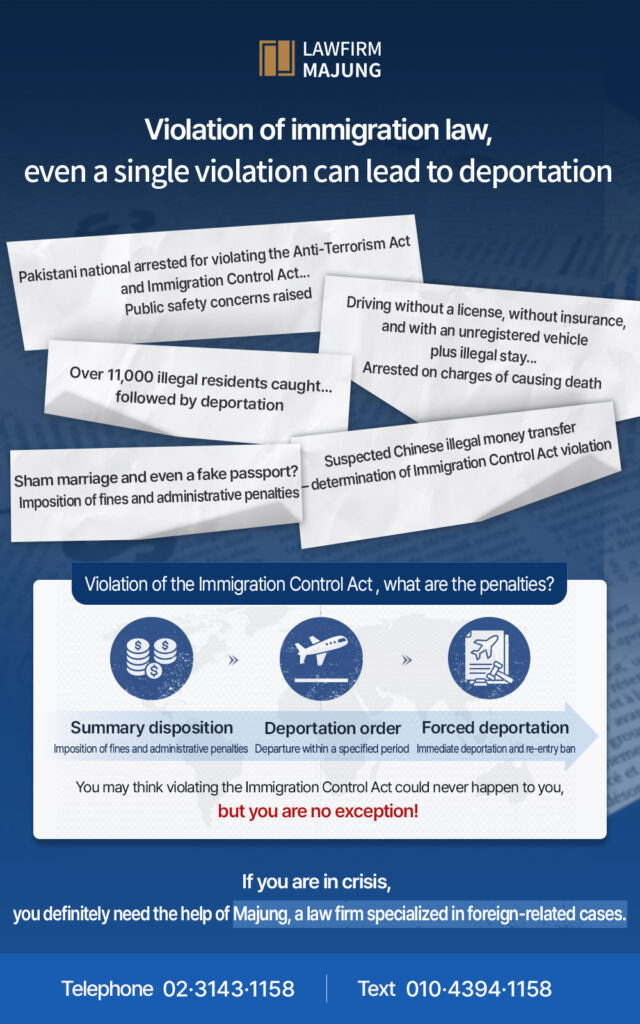
Violating the Immigration Act may result in more than a fine—it may ultimately lead to deportation.
Deportation is an administrative measure that is separate from criminal punishment and results in the termination of a foreign national's right to remain in Korea.
💡 It may have consequences such as
For individuals planning to remain in Korea long-term or living with their families, these consequences can be especially significant.
3. If There Is No Criminal Punishment, Is the Case Completely Over?
The most important factor in these cases is 'early response.'
Once an issue arises concerning a foreign national's immigration status, restoring that status may be extremely difficult. For this reason, establishing the right strategy from the very beginning is essential.
In particular, once a fine exceeding a certain level becomes final, immigration authorities may use it as grounds to
However, responding appropriately involves much more than simply explaining.
In other words, both the criminal outcome and the individual's immigration status should be considered together when developing an appropriate legal strategy.
4. The Role of an Immigration Lawyer
Immigration-related cases involve both criminal and administrative procedures.
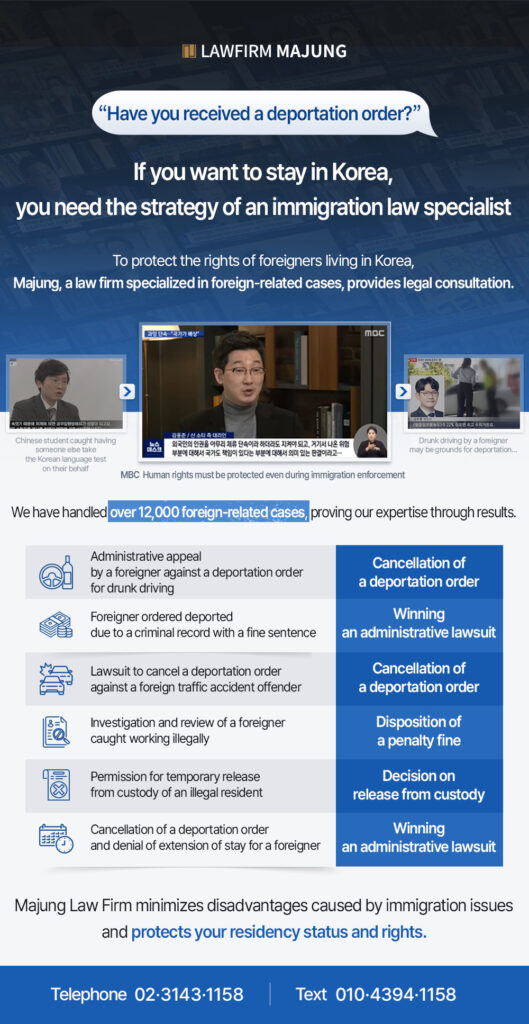
For example, even if a foreign national has already been punished for unauthorized employment, immigration authorities may still conduct a separate review to determine whether that person should be allowed to maintain their immigration status. For this reason, responding only to the criminal proceedings is often insufficient to manage the overall legal process.
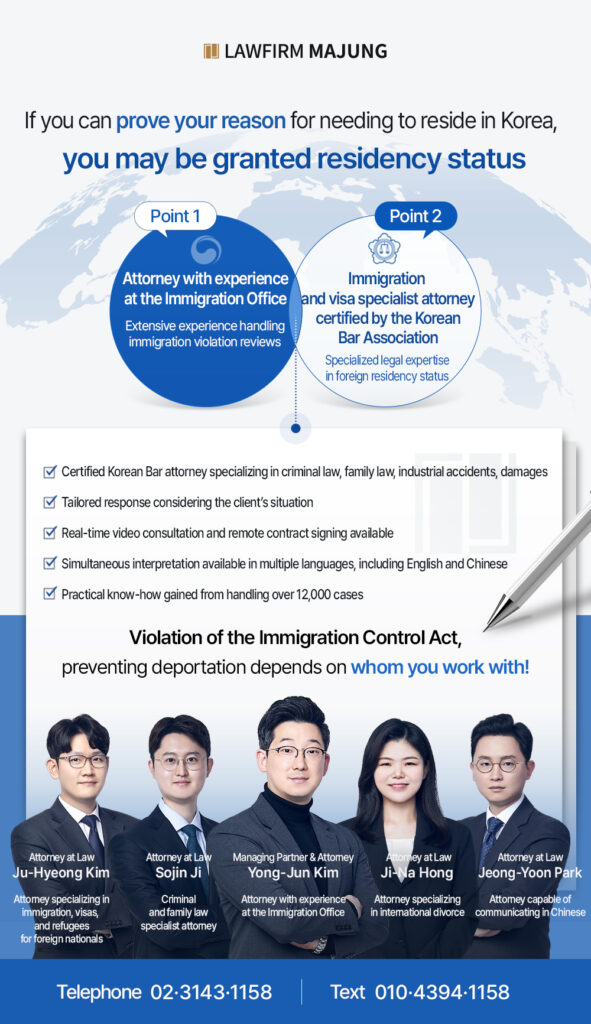
An immigration lawyer helps establish a strategy that considers immigration risks from the earliest stage and continues to guide every subsequent procedure.
At Majung Law Firm, we handle Immigration Act cases through the following approach
Particularly in cases where maintaining immigration status is critical, we provide practical legal strategies based on real case experience.
Violations of the Immigration Act are not simply criminal matters—they may affect your future residence and your overall life in Korea. If your situation is complicated or you are unsure how to proceed, organizing the overall legal strategy from the earliest stage is essential.
The outcome of an immigration case often depends on when and how you respond. We encourage you to choose the most stable course of action based on the experience and understanding of immigration lawyers who regularly handle cases involving foreign nationals.
Thank you.
Multilingual consultation available in English and Chinese.
Professional interpreters assist from the first consultation to the conclusion of the case.
Offices in Seoul, Daejeon, Busan, Daegu, and Gwangju
Don’t face the legal system alone. Let Majung fight for you!