
Many people think, "It's only been a few days—it should be fine." However, once they stand before an immigration officer, they often realize the seriousness of the situation. This concern becomes even greater if they plan to re-enter Korea in the future or are preparing to change their immigration status.
In many cases, individuals assume that overstaying by only a few days will not be a problem, only to find themselves facing potential Immigration Act violations, criminal penalties, and even an Immigration Offender Review, depending on the circumstances.
Because Immigration Act violation cases can be highly complex, we recommend seeking assistance from Majung Law Firm's immigration lawyers, who have extensive experience handling cases involving foreign nationals and can develop a tailored response strategy for your situation.
1. Understanding the Nature of an Immigration Act Violation
When an Immigration Act issue arises, many foreign nationals become overwhelmed because they are unsure whether they are facing an administrative issue or a matter that could lead to criminal punishment.
Simply being discovered is frightening enough, and because most people are unfamiliar with the legal procedures, they often wonder
From the very beginning, it is important to determine whether the matter could lead to criminal penalties for a foreign national.
The answer depends on factors such as whether the issue involves only an overstay or also includes activities beyond the authorized immigration status. If the case becomes subject to an Immigration Offender Review, additional consequences, including entry restrictions, may also follow.
2. Three Common Types of Immigration Violations
The following are the three most common types of Immigration Act violations.
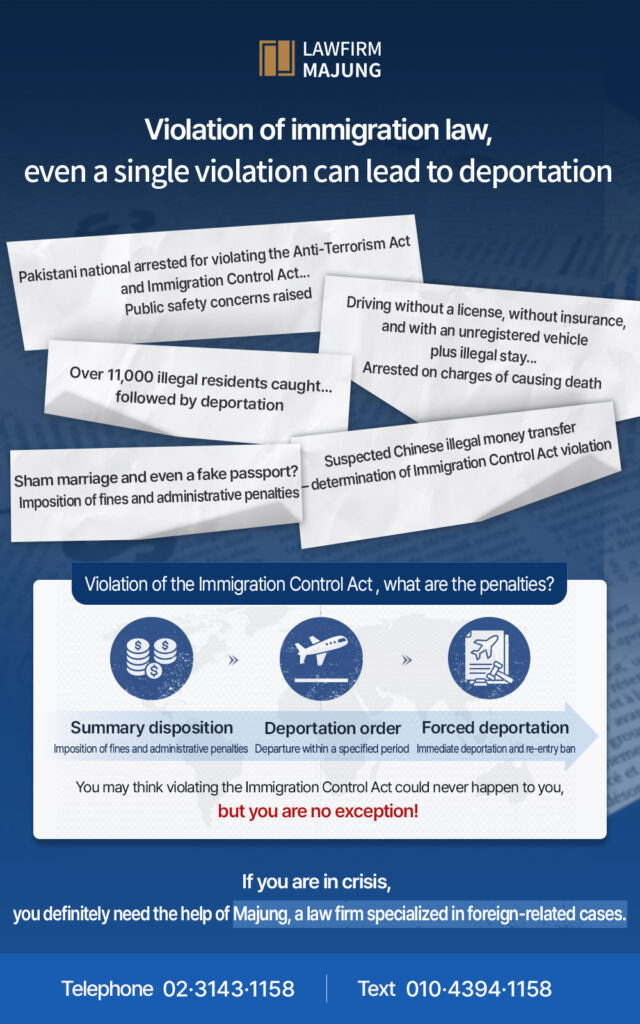
Under the Immigration Act, these violations may result in criminal penalties of up to three years' imprisonment or a fine of up to KRW 30 million. Depending on the circumstances, administrative measures such as fines, Departure Orders, or deportation may also be imposed.
Rather than assuming the matter is insignificant, it is important to accurately determine which category applies and prepare an appropriate response.
3. Criminal Penalties for Foreign Nationals: Distinguishing Between Honest Mistakes and Criminal Violations
Not every Immigration Act violation results in criminal punishment. However, immigration authorities generally consider several important factors when determining whether criminal penalties should apply.
These factors are also reviewed during the Immigration Offender Review, making it important to organize them carefully from the beginning.
For example, even where two individuals have both overstayed their visas, the appropriate response may differ significantly depending on whether the overstay lasted only a few days due to an honest mistake or continued for several months while engaging in unauthorized employment.
Accordingly, it is not enough simply to calculate the length of the overstay. It is equally important to clearly explain what activities occurred during that period and the personal circumstances surrounding the violation. Failing to do so may lead to unnecessary disadvantages.

4. Immigration Act Violations: Documents and Attitude Often Determine the Outcome
When an Immigration Act violation occurs, the outcome often depends on the available records and the individual's response.
Immigration authorities commonly review the following
Simply saying, "I didn't know," is generally insufficient. Instead, it is important to explain why the violation occurred, what personal circumstances existed, and what actions were taken, supported by appropriate documentation.
Particularly where the case may lead to criminal penalties or an Immigration Offender Review, the way these records are organized can significantly affect the outcome.
For this reason, responding based on experience rather than guesswork is extremely important, and working with an immigration lawyer who has practical experience handling these cases is highly recommended.
Although Immigration Act violations may appear to be simple administrative matters, the circumstances surrounding the violation and the way the case is handled may ultimately lead to both administrative measures and criminal proceedings.
For foreign nationals in particular, criminal penalties and Immigration Offender Reviews are often considered simultaneously, making an appropriate response from the earliest stage extremely important.
Whether your situation is simply an honest mistake or constitutes a legal violation, the first step is to accurately organize the facts and supporting documentation. Understanding what documents should be submitted and how they should be prepared is essential from the very beginning.