
Many cases that appear to be simple criminal matters eventually lead to deportation proceedings for foreign nationals.
What may seem like a minor violation can later be interpreted differently during an Immigration Offender Review, putting your immigration status at risk.
The most important step is not an emotional explanation— it is understanding the legal standards that determine whether deportation is likely .
It is also essential to distinguish between a Departure Order and Deportation, as they are entirely different legal procedures. Failing to understand the difference can result in an ineffective legal strategy.
1. Understanding the Different Types of Immigration Measures
Many people assume that "deportation" is a single legal action, but there are several different immigration measures.
The most common include:
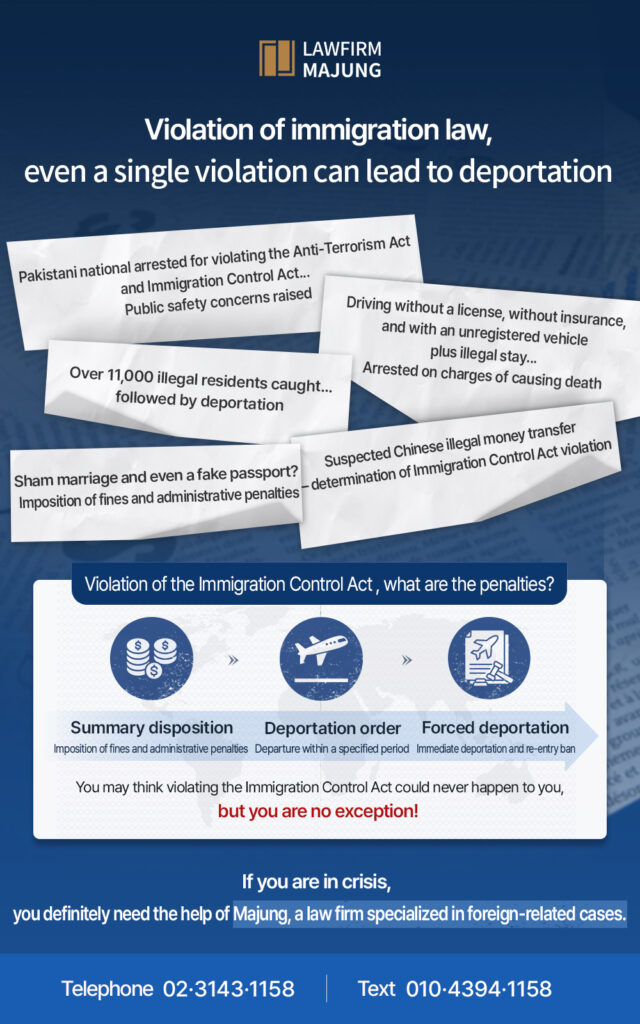
A Departure Order requires the individual to voluntarily leave Korea within a specified period. Failure to comply may result in more severe enforcement measures .
A Deportation Order , on the other hand, is enforced directly by the government and may also result in a ban on re-entering Korea.
An Immigration Offender Review plays a crucial role in determining which measure will ultimately be imposed.
2. Deportation Is Not Determined Solely by the Violation
A foreign national is not automatically deported simply because a violation has occurred .
Instead, immigration authorities evaluate the case through an Immigration Offender Review by considering factors such as
Even when two individuals commit the same violation, one may receive only a Departure Order while another may face Deportation.
The outcome often depends not only on the facts themselves, but also on the way the case is presented and supported . This makes strategic preparation by an immigration attorney especially important.
3. Why Immigration Reviews Produce Different Results
Many people underestimate the importance of the Immigration Offender Review .
In reality, it is the key process that determines whether a foreign national will be allowed to remain in Korea.
During the review, the consistency of statements and well-organized supporting documents is extremely important. Without proper preparation, problems such as the following may occur.
On the other hand, careful preparation may significantly improve the chances of avoiding deportation .
4. What Can You Do After Receiving a Departure Order?
Receiving a Departure Order does not necessarily mean the process is over.
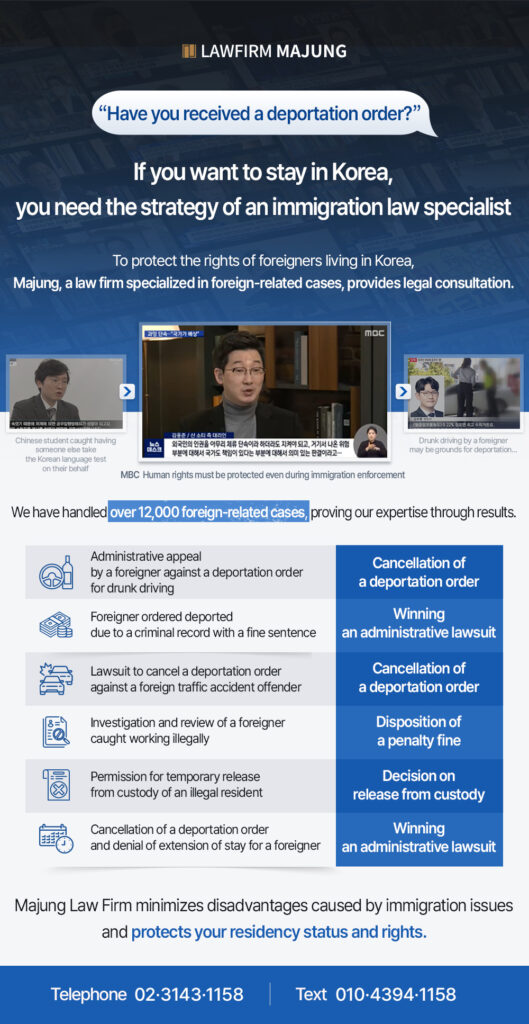
Depending on the circumstances, it may be possible to challenge the decision through an administrative appeal or administrative lawsuit . Important considerations include
If there is a possibility that the case may escalate into Deportation, filing an application to suspend enforcement should also be considered.
Simply explaining personal circumstances is usually not enough. Instead, evidence should be prepared in a way that addresses the standards used during the Immigration Offender Review. Strategic legal representation is particularly important during this stage.
5. Key Strategies for Avoiding Deportation
From a practical standpoint, timing is one of the most important factors.
The longer you wait after receiving an immigration notice, the fewer legal options may remain. Key strategies include
All of these factors can influence whether deportation will ultimately be ordered .
6. Protecting Your Right to Remain in Korea
It is especially important to understand the difference between a Departure Order and Deportation, as their legal consequences are significantly different.
The Immigration Offender Review is often the most critical stage of the entire process. Without proper preparation, the risk of an unfavorable outcome increases considerably.
By organizing your case from the very beginning with the guidance of an experienced immigration attorney, you may significantly improve your chances of avoiding deportation and protecting your right to remain in Korea.