Foreigners Involved in Voice Phishing in Korea
There continues to be a rise in cases where foreigners, lured by the promise of making quick money, apply for what appears to be a simple part-time job—only to find themselves acting as a “collector” or “money mule” for a voice phishing organization.
At first, these tasks may seem like harmless delivery or withdrawal duties.
However, such actions are legally considered direct involvement in the transfer of criminal funds, and the punishment can be much more severe than for general fraud.
Furthermore, claiming “I didn’t know” is rarely accepted by investigative agencies or the court as a valid excuse for avoiding responsibility.
In particular, if your initial statements are poorly recorded or your response to immigration-related procedures is delayed during the early stages of the investigation, what could have ended as a minor inquiry may escalate into a criminal conviction or forced deportation.
Voice phishing scams involving foreigners do not end with the investigation alone. Language barriers, visa status, and immigration history all become critical factors.
For foreign nationals, facing this kind of legal situation without proper support can be incredibly difficult.
Contents
1. What Are the Penalties for Foreigners Involved in Voice Phishing in Korea?
2. Can a Fine Alone Lead to Deportation?
3. Pakistani International Student Falsely Accused of Fraud Wins Civil Case Dismissal – Real Case Example
4. Why Legal Representation Is Essential in Voice Phishing Cases Involving Foreigners
1. What Are the Penalties for Foreigners Involved in Voice Phishing in Korea?
At first, involvement may seem minor, but the penalties can be much more severe than expected.
If a foreigner is involved in a voice phishing case, they are typically charged with fraud, which carries a penalty of up to 10 years in prison or a fine of up to 20 million KRW.
Furthermore, if it is proven that the individual actually handled or withdrew the victim’s money, the Act on the Aggravated Punishment, etc. of Specific Economic Crimes will be applied, leading to significantly harsher sentences.
The larger the amount involved, the more likely the court is to impose a prison sentence. Even first-time offenders have consistently received strict punishments.
2. Can a Fine Alone Lead to Deportation?
More important than the type of criminal punishment received is how that punishment is regarded during immigration review.
If a foreigner is convicted of fraud-related charges, deportation procedures may be initiated separately from the criminal penalties, depending on the criteria.
Even if the punishment is light, immigration authorities consider records and convictions when deciding on deportation, so even a single case can have a significant impact.

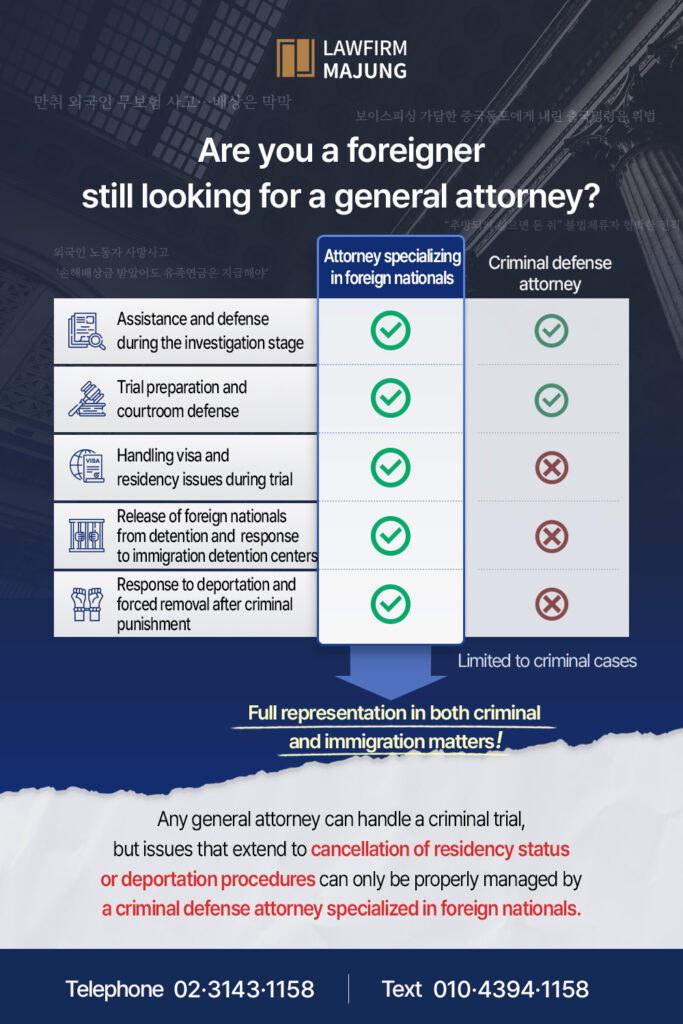
4. Why Legal Representation Is Essential in Voice Phishing Cases Involving Foreigners
When foreign nationals are investigated for fraud-related offenses, immigration procedures are often overlooked or addressed too late.
Voice phishing cases involving foreigners don’t simply end with criminal penalties—the outcome can directly impact immigration status and visa eligibility.
Focusing only on the criminal aspect without addressing immigration implications can lead to an unbalanced and ineffective response.
Multilingual consultation available in English and Chinese.
Professional interpreters assist from the first consultation to the conclusion of the case.
Offices in Seoul, Daejeon, Busan, Daegu, and Gwangju.
Don’t face the legal system alone. Let Majung fight for you!
Member in charge
이 사건 담당 전문가

Ju-Hyeong Kim
Deputy Managing Partner
Certified Specialist in Immigration and Visa Law

Sojin Ji
Vice Managing Partner
Certified Specialist in Criminal and Family Law

Ji-Na Hong
Partner Associate
Foreign Nationals Legal Specialist

Yong-Jun Kim
Managing Partner & Attorney
Immigration Enforcement Officer Attorney

Jeongyoon Park
Partner Associate
Foreign Nationals Legal Specialist