
“I just delivered something… that’s all.”
Contents
1. How severely are foreign nationals punished for voice phishing crimes?
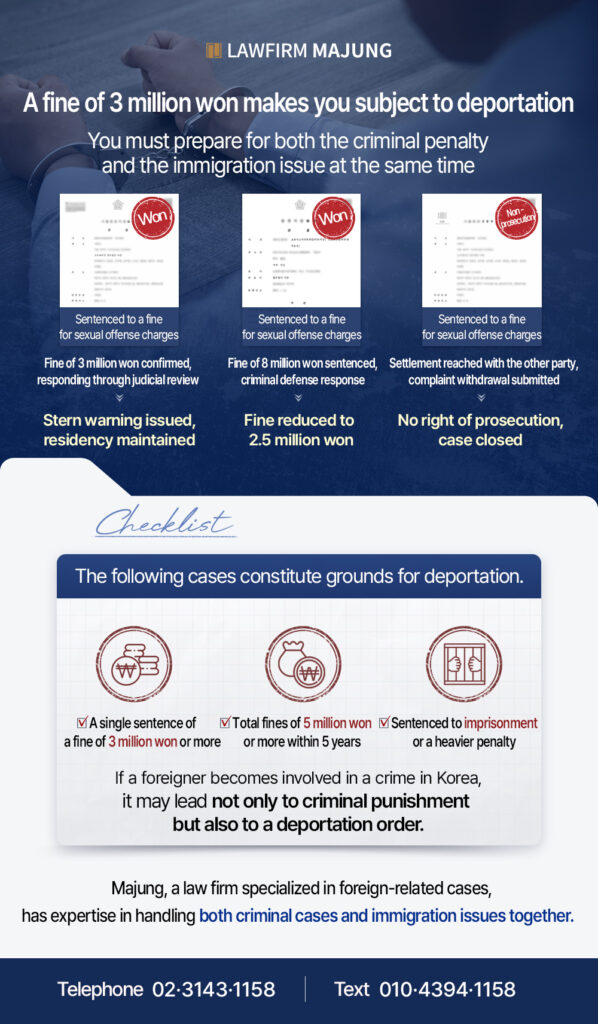
Even if it was considered a simple mistake, investigators assess the case based on the actual role you played in the incident. Voice phishing involving foreign nationals is generally classified as fraud, which can result in up to 10 years of imprisonment or a fine of up to 20 million KRW. However, if money transfers were repeated or multiple victims were involved, the case may also fall under the Act on the Aggravated Punishment of Specific Economic Crimes, leading to much harsher penalties. One important point to remember is that for foreign nationals, consequences continue even after criminal sentencing — through separate immigration procedures. If a foreign national receives a conviction resulting in imprisonment or a suspended prison sentence for fraud or another criminal offense, it is not uncommon for deportation orders or forced removal proceedings to follow afterward.
2. If you’re being investigated for a crime as a foreign national, what should you prepare first?
If you are being investigated for voice phishing as a foreign national, the attitude and approach you take in the early stages can significantly shape the direction of your case. Here are several key steps you should prepare in advance:
3. “I thought it was just a part-time job…” — A real case of a foreign national investigated as a voice phishing money courier.
A, a Canadian student studying in Korea, was working various part-time jobs to cover living expenses when a friend introduced a short-term task. At first, A thought it was just a simple errand. However, A later realized that the job involved receiving cash from a voice phishing victim and passing it to another person. Eventually, A was identified as a “money collector” and became the subject of a criminal investigation involving a foreign national. Most of the work had been conducted remotely, and the payment was deposited directly into A’s own bank account, making it difficult for A to recognize that the activity was illegal. During the investigation, with the help of a legal representative, A actively explained that: ① A was an international student who had been residing in Korea for an extended period, ② the task was understood to be a simple errand without any criminal intent, and ③ A’s family was also living in Korea — emphasizing the lack of intent to commit a crime. Even though no settlement was reached with the victim, the prosecution considered the overall circumstances and statements and ultimately issued a “no charges” (non-suspicion) decision. As a result, A was able to conclude both the criminal process and immigration matters without facing any further disadvantages.

4. Why is the help of a legal representative essential in fraud cases involving foreigners?
When a foreign national becomes involved in a voice phishing case, it often leads not only to criminal punishment but also to an immigration review by the authorities. In such cases, a criminal record can negatively affect residency evaluation, and depending on the circumstances, it may result in a departure order or even a re-entry ban. Therefore, when responding to a criminal case involving a foreign national, it is essential to prepare for both the criminal process and the subsequent immigration procedures simultaneously. An experienced legal representative familiar with fraud cases involving foreigners typically establishes a defense strategy through the following steps:
Because fraud cases involving foreign nationals affect both the criminal process and immigration review, addressing only one side is not enough to fully resolve the issue. A coordinated approach is essential to protect both legal and residency status.
5. Why should criminal charges and immigration issues be handled together?
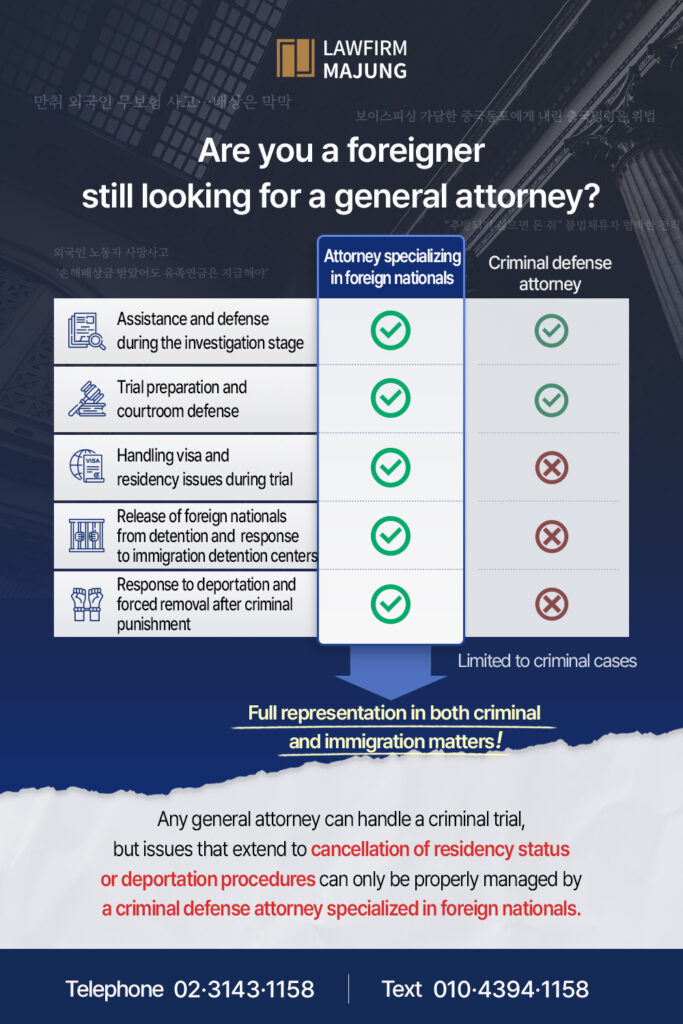
How can a legal representative familiar with immigration procedures help? They review in advance how a criminal or fraud case involving a foreign national may affect your visa or residency review, and help you prepare explanatory statements and supporting documents that clearly present your position.
How does an attorney experienced in criminal cases respond? From the early stages of the investigation, they clarify your stance, and during trial, they organize and present key factors such as the circumstances of the incident, the content of statements, and evidence of remorse to positively influence the sentencing outcome.
Although criminal proceedings and immigration reviews are conducted separately, both are often affected by the same underlying issue. When both procedures are addressed in a coordinated and strategic manner, the outcome can be much more stable and favorable.