
I might be involved in a criminal case related to a drug offense in Korea...
In particular, drug possession cases involving foreign nationals are a typical example where criminal outcomes and immigration decisions operate simultaneously.
The results may vary depending on factors such as whether it was simple possession, whether there was actual drug use, and whether it is a first-time offense.
However, the key point is that both criminal and immigration procedures proceed at the same time.
Today, we will walk you through the key issues—including visa implications, first-offense considerations, penalty standards, and the possibility of maintaining residency.
1. Are foreign nationals punished the same as Korean nationals for drug possession?
In these cases, the criminal punishment standards themselves are applied the same as for Korean nationals.
In other words, under the Narcotics Control Act, the level of punishment is determined based on whether the offense involves possession, use, or distribution.
However, the key difference arises after that stage.
In drug possession cases involving foreign nationals, an additional review is conducted by immigration authorities after the criminal proceedings.
During this process, factors such as the nature of the offense, the likelihood of reoffending, and the necessity of remaining in Korea are comprehensively evaluated.
Ultimately, this is not simply a matter that ends with a fine or a suspended sentence—the critical point is that your immigration status itself may be at risk.

2. Can the outcome vary depending on the type of visa?
In drug possession cases involving foreign nationals, the outcome can vary depending on the type of visa the individual holds.
For example:
- Short-term visas
- Student visas
- Work visas
- Long-term visas such as F-4 or F-5
Each category may be subject to different standards in immigration review.
In particular, in these types of cases:
- The shorter the visa duration, the higher the likelihood of a departure order
- For long-term visas, individual circumstances tend to carry more weight
However, an important point to note is that having a long-term visa does not guarantee safety.
Because drug-related offenses may be considered to have a high level of social harm, strong measures can still be taken regardless of visa type.
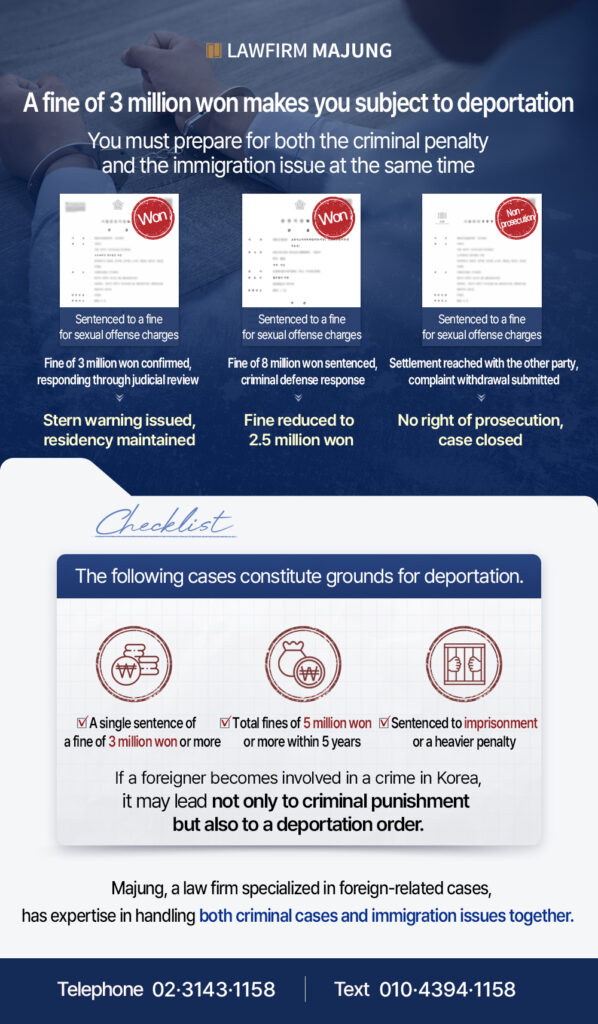
3. If it is a first offense, will it always be treated leniently?
Many people believe that “it’s okay if it’s a first offense,” but in reality, it’s not that simple.
Being a first-time offender is certainly an important factor.
However, in drug possession cases involving foreign nationals, the following elements are also considered:
In other words, being a first-time offender alone does not guarantee a lenient outcome or the ability to maintain residency.
The decision is based on a combination of factors—including first-offense status, severity of the case, and immigration circumstances—so the direction of your response in the early stages can significantly influence the final outcome.

4. What happens in the immigration process after criminal punishment?
After the criminal procedure ends in a drug possession case involving a foreign national, the process may continue into the immigration stage.
At this point, authorities may conduct an immigration offense review, and decide on measures such as a departure order or deportation.
Even if the criminal outcome results in a relatively lighter sentence—such as a fine or a suspended sentence—immigration authorities may still make a separate determination.
In other words, a lighter criminal penalty does not guarantee that your residency will be maintained.
At this stage, it is important to clearly present and explain factors such as:
- Family relationships in Korea
- Economic activities
- Length of stay
- Likelihood of reoffending
5. If you receive a suspended sentence, can your visa still be maintained?
One of the most frequently asked questions in drug possession cases involving foreign nationals is this issue.
To give you the conclusion first, receiving a suspended sentence does not automatically mean that your visa will be maintained.
In these cases, criminal results and immigration decisions are handled separately.
Therefore, even after receiving a suspended sentence, the following outcomes may still occur:
However, if the circumstances of the case, the likelihood of reoffending, and the individual’s ties and stability in Korea are sufficiently demonstrated, there may still be a possibility of maintaining residency.
Ultimately, in these types of cases, what is more important than the criminal outcome is the overall strategic approach.
If a drug possession case involving a foreign national is approached solely as a criminal matter, important aspects may be overlooked.
The key point is that both criminal and immigration issues must be addressed together.
Which Law Firm should you visit?
At Majung Law Firm, we respond to these cases in the following way:
A collaborative structure is used to review both criminal and immigration issues together when setting the direction of the case
For foreign nationals, the timing of the response can significantly affect the outcome.
Establishing the right strategy from the early stages is important in order to protect not only the legal outcome but also the ability to remain in Korea.
If you are currently facing such concerns, it is recommended that you seek assistance from a legal professional.
Multilingual consultation available in English and Chinese.
Professional interpreters assist from the first consultation to the conclusion of the case.
Offices in Seoul, Daejeon, Busan, Daegu, and Gwangju
Don’t face the legal system alone. Let Majung fight for you!