
DUI Penalties for Foreign Nationals in Korea
I need a lawyer in Seoul due to my arrest. Penalties for drunk driving involving foreign nationals are not simply criminal punishments for violating traffic laws, but rather a complex legal issue that can significantly affect a foreign national’s status and overall residency in Korea.
Many people assume that being caught for drunk driving ends with paying a fine. However, for foreign nationals, even after the criminal process is completed, a separate immigration procedure may follow, potentially leading to entirely different outcomes.
In particular, for those staying in Korea under specific visa categories such as employment, investment, or student visas, even a single DUI incident can negatively impact future visa extensions, permanent residency applications, or naturalization reviews.
① Criminal Liability and Immigration Consequences Must Be Reviewed Together
If the blood alcohol concentration exceeds a certain level, a driver’s license may be suspended or revoked. In cases where the level is high or an accident is involved, the penalty may go beyond a fine and extend to a suspended sentence or imprisonment.
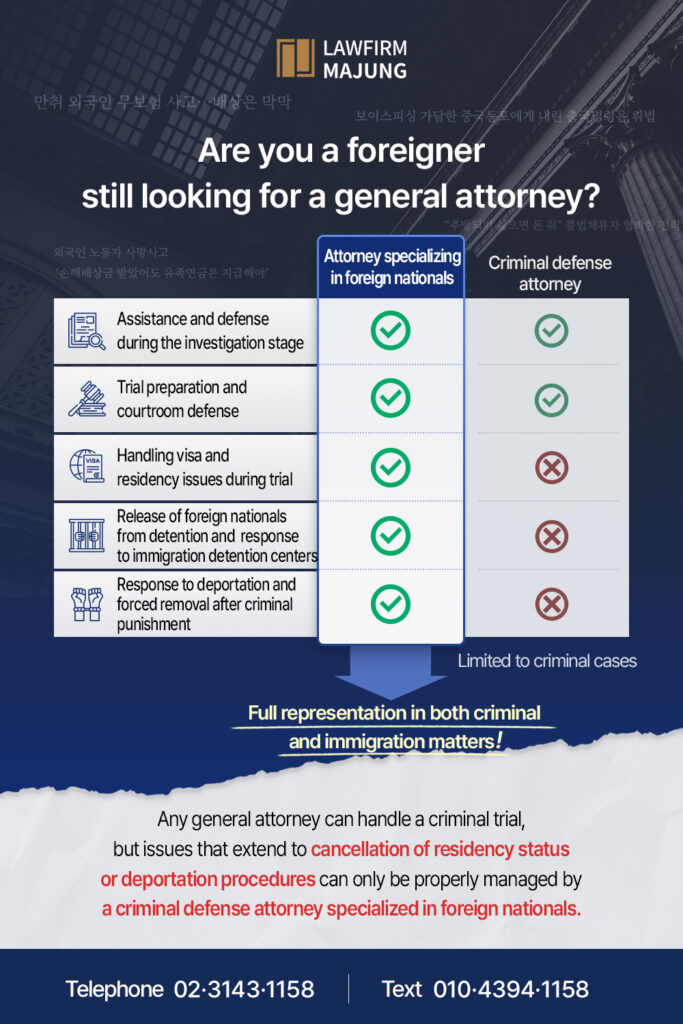
However, the issue does not necessarily end with the criminal judgment. Separate from the criminal procedure, immigration authorities may review whether the conduct violated public order in Korea, whether there is a risk of reoffending, and whether continued residence should be permitted.
During this process, the possibility of deportation due to drunk driving may be examined. If the matter is regarded as serious, it may lead to a departure order or deportation order, depending on the circumstances of the case.
② Early-Stage Response May Affect the Outcome of the Case
Factors such as the statement given at the time of detection, the circumstances of drinking, the distance driven, whether an accident occurred, and whether there were passengers in the vehicle may all be taken into account when determining the sentence.
In particular, statements prepared without proper interpretation, or documents signed without fully understanding their meaning, may later be used as unfavorable evidence.
From the investigation stage, it is important to clearly understand one’s rights and carefully review the meaning and legal implications of any statement or document before signing it.
③ Repeat Offenses and Residency Status Are Important Factors
If there is a prior history of drunk driving, the case may be less likely to be resolved with a simple fine. Immigration authorities may also regard a repeated offense as an indication of a higher risk of reoffending.
Factors such as whether the person is a short-term or long-term resident, whether they are living with family, and the stability of their employment in Korea may also be considered comprehensively.
For example, someone who has worked long-term for a domestic company and consistently paid taxes may be evaluated differently from someone who committed a violation shortly after entering the country. However, these circumstances may not be sufficiently reflected unless the individual actively presents and explains them.
In particular, when deportation or a departure order is being considered, it may be important to provide concrete evidence regarding the facts of the case, a sincere attitude of remorse, and a clear plan to prevent recurrence.

④ A Case Involving a Foreign National Working in a Technical Position
In one case, a foreign national working in a technical position in Korea was caught at a DUI checkpoint after driving home from a gathering with acquaintances.
At the time, the blood alcohol concentration exceeded the level for license revocation. No traffic accident occurred, but due to the high alcohol level, the severity of the criminal and immigration consequences became a key issue. While the investigative authorities recommended a fine, immigration authorities also notified the individual that the possibility of deportation would be reviewed.
As a result, the criminal court imposed a relatively lower fine, and at the immigration stage, the client was permitted to continue residing in Korea.
This case demonstrates that, beyond seeking to reduce the criminal penalty, a strategy that also addresses immigration stability may be important.
⑤ Residency in Korea May Be the Foundation of One’s Livelihood, Family, and Future
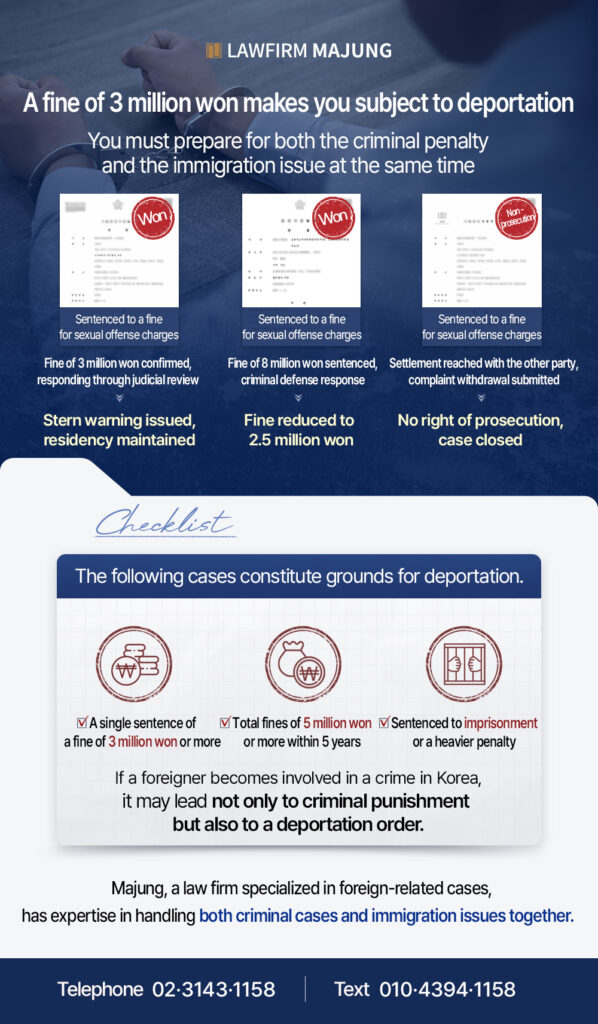
DUI cases involving foreign nationals may go beyond the immediate issue of criminal punishment and can lead to serious consequences such as loss of residency status, a departure order, or deportation.
In particular, if a deportation decision is made due to drunk driving, re-entry may be restricted for a certain period. This may result in career disruption and may also affect the individual’s family life and long-term plans.
Therefore, in DUI cases involving foreign nationals, it is important not to focus solely on the amount of the fine. Long-term residency strategy and the possibility of maintaining lawful status should also be reviewed.
A legal professional with experience in this field may review the criminal and immigration procedures together and develop a response strategy tailored to the specific circumstances of the case.
Even when unexpected enforcement action causes anxiety and uncertainty, a structured review of the facts, evidence, criminal procedure, and immigration consequences may help identify an appropriate path forward.