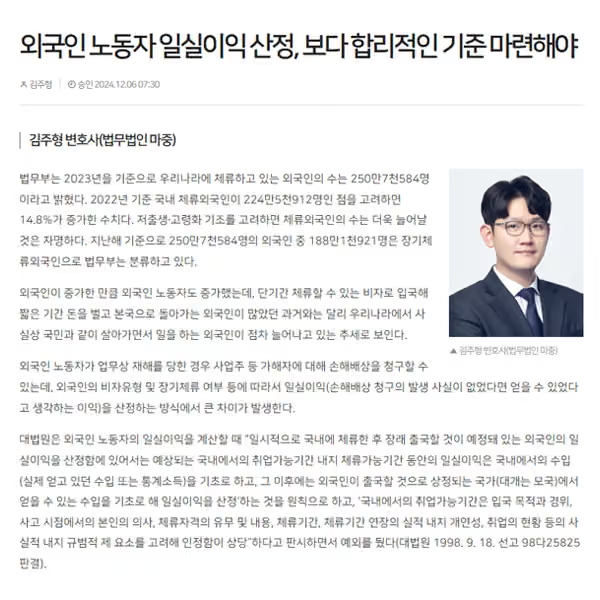
The Ministry of Justice announced that as of 2023, the number of foreigners residing in Korea reached 2,507,584. This represents a 14.8% increase compared to 2,245,912 in 2022. Considering Korea’s trend of low birth rates and population aging, it is evident that the number of foreign residents will continue to grow. Of the 2,507,584 foreigners recorded last year, 1,881,921 were classified by the Ministry as long-term residents.
As the number of foreigners has increased, so has the number of foreign workers. Unlike the past, when many foreigners entered on short-term visas to earn money and quickly return to their home countries, an increasing number are now settling in Korea and working here much like Korean citizens.
The Supreme Court has held that when calculating lost earnings for a foreigner who is staying only temporarily in Korea with the expectation of leaving in the future, the calculation should be based on income in Korea (actual earnings or statistical income) only for the period the person is reasonably expected to remain in Korea. After that, the calculation should be based on the income the foreigner would likely earn in the country to which they would return (usually their home country). The Court added that the period of possible employment in Korea should be determined by considering factors such as the purpose of entry, the circumstances of entry, the foreigner’s intentions at the time of the accident, visa status and content, period of stay, record or likelihood of extension, and actual employment situation (Supreme Court Decision 98다25825, Sept. 18, 1998).
Nonetheless, lower courts have recognized exceptions to this principle. They have acknowledged that foreigners holding permanent residency visas (F-5) or overseas Korean visas (F-4), who can continuously extend their stay unless convicted of a serious crime or violating immigration laws, may have their lost earnings calculated based on Korean income. Recent examples include rulings by the Seoul Central District Court (Decision 2022가합535919, June 8, 2023) and the Seoul Eastern District Court (Decision 2021가단134568, July 22, 2022).
However, in today’s Korea, countless foreigners — not only permanent residents or overseas Koreans — live here for decades, establish families, and integrate into society under a variety of visa types. Unfortunately, the courts still tend to strictly apply the formal requirement of visa type, in addition to substantive conditions, and are reluctant to recognize exceptions.
In an era of globalization, foreigners are becoming de facto members of Korean society both socially and economically. It is therefore time to actively discuss the creation of a more reasonable standard for calculating lost earnings for foreigners.
Source: Maeil Labor News
Majung offers legal consultations for foreign residents in Korea who need legal assistance. Please contact us at the number below for more detailed advice.
Majung Law Firm Foreign Center: 02-3143-1158