Need for Government-Mandated Language Education Program
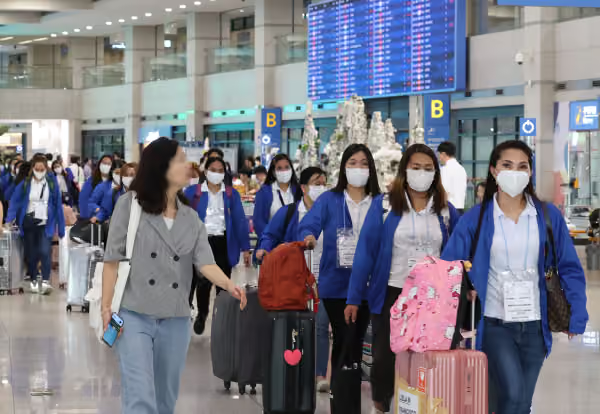
Maeil Ilbo = Reporter Choi Han-gyeol | For the first time ever, the number of foreign workers in Korea has surpassed 1 million. The resident foreign population has also exceeded 1.5 million, marking another first. As a result, foreign labor is no longer considered optional but rather an essential part of Korea’s industrial workforce. However, challenges such as language barriers remain pressing issues to address.
According to Statistics Korea’s “Immigrant Residence and Employment Survey” released on the 18th, there were 1.561 million foreign nationals aged 15 or older who stayed in Korea for more than 91 days, a 9.1% increase from a year earlier. Of these, 1.01 million were employed, up 9.4% from the previous year.
Currently, foreign workers make up 3.5% of Korea’s total workforce (28.915 million workers).
The increase in foreign employment was driven by growth in both non-professional employment (E-9 visa) and skilled professionals. The number of non-professional workers rose by 34,000 (12.6%), while skilled professionals increased by 19,000 (39.9%). This is attributed to the expansion of foreign worker admissions (165,000) and relaxed visa conversion requirements.
Foreign workers’ wages and real estate ownership have also increased. Among foreign employees, 956,000 were wage workers and 54,000 were self-employed, with most earning more than 2 million KRW per month.
As of May, according to the Korea Real Estate Board, 93,414 foreign nationals owned homes in Korea. Among them, 87,057 owned apartments and 8,516 owned detached houses. Multi-homeowners with two or more properties accounted for 6.6% of foreign property owners.
Industries such as manufacturing, construction, and agriculture/fisheries are finding it increasingly difficult to operate without foreign workers.
According to the Ministry of Employment and Labor, 86% of newly hired workers in the shipbuilding industry were foreigners. The Construction Workers Mutual Aid Association reported that as of March, foreigners accounted for 16.2% of all construction site workers enrolled in the retirement savings scheme.
Given Korea’s declining birthrate and looming labor shortages, there is growing consensus on the need for institutional support for language education programs targeting foreign workers.
Majung offers legal consultations for foreign residents in Korea who need legal assistance. Please contact us at the number below for more detailed advice.
Majung Law Firm Foreign Center: 02-3143-1158