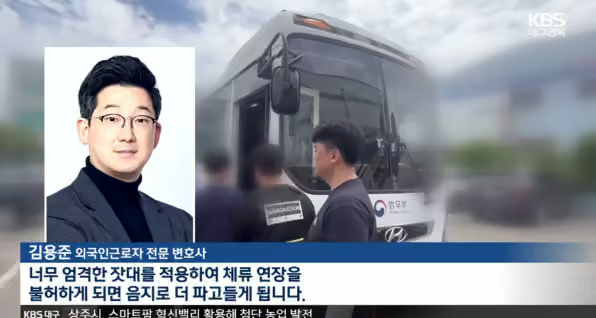
[KBS Daegu] [Anchor] This is the final segment in our special series on undocumented immigrants.
Despite calls from the field, the government continues to pursue an enforcement-first policy toward undocumented immigrants. Yet, with undocumented workers having effectively become a key pillar of the labor supply, critics argue it is time to bring them into the legal system.
Reporter Seo Han-gil has the story. [Report]
Between barbed wire and factory walls lies a narrow passage, barely wide enough for a person to slip through—a prepared escape route in anticipation of immigration crackdowns.
Pre-installed makeshift ladders make it easy to climb out of windows or over tall fences. If escape fails, some take the risk of hiding in the narrow gaps between machines.
With the undocumented immigrant population now reaching 400,000 in Korea, human rights groups say the government’s harsh enforcement policy must change.
[Kim Hee-jung / Executive Committee Member, Daegu-Gyeongbuk Migrants’ Solidarity Conference] “We need to identify and improve the root causes that lead to undocumented migrants. Only then will we reduce both the number of undocumented residents and the need for crackdowns.”
The foreign worker quota system, originally introduced to protect domestic employment, is proving ineffective in industries that Koreans largely avoid.
For small and mid-sized cities and rural areas, economic activity has long been nearly impossible without undocumented workers.
[Lee Sung-soon / Former Member, Prime Minister’s Office Foreigners Policy Committee] “We expect further decline in regional economic vitality and acceleration of local depopulation. It’s time we consider legalization measures more positively.”
This is why demands are growing for the introduction of a domestic labor quota system tailored to local needs, along with the legalization of undocumented workers.
In an era of declining birth rates, there is urgent need for realistic alternatives that can both address labor shortages in smaller cities and protect the human rights of undocumented immigrants.
KBS News, Seo Han-gil.
Cameraman: Shin Sang-eung