
Foreign national traffic accidents rarely end as simple traffic incidents.
In many cases, a traffic accident involving a foreign national may lead not only to criminal proceedings but also to an Immigration Offender Review, making the nature of the case significantly more complex.
Many people assume that "If I only receive a fine, the matter is over." However, in reality, immigration authorities may separately determine whether the individual may continue to remain in Korea during the Immigration Offender Review, which can lead to a very different outcome.
Just like cases involving sexual offenses committed by foreign nationals, traffic accident cases involving foreign nationals often involve both criminal proceedings and immigration procedures at the same time. Therefore, responding appropriately from the very beginning is extremely important.
1. Leaving the Scene After a Traffic Accident: When Does It Become a Legal Issue?
Leaving the scene after a traffic accident does not automatically constitute a serious criminal offense.
However, in cases involving foreign nationals, there is a significant possibility that the conduct may be considered a failure to take the required measures after a traffic accident, which may also affect the Immigration Offender Review.
💡 The following situations commonly become legal issues.
These circumstances may be considered a failure to take the required post-accident measures and may become unfavorable factors during the Immigration Offender Review.
2. Failure to Take Required Measures After an Accident and Criminal Liability
One of the most important issues in traffic accident cases involving foreign nationals is whether the driver recognized that an accident had occurred.
There is a substantial legal difference between failing to notice an accident and knowingly leaving the scene after becoming aware of it. At the same time, the Immigration Offender Review proceeds independently from the criminal proceedings.
As with criminal cases involving sexual offenses committed by foreign nationals, the following factors are particularly important:
👉 A traffic accident involving a foreign national is evaluated not merely as an accident, but based on the available evidence and how the facts can be established.
3. Situations That May Result in More Severe Penalties
The severity of punishment may increase significantly if any of the following circumstances are present:
In these situations, the case is likely to proceed not only through criminal prosecution but also through an Immigration Offender Review.
Just as with criminal cases involving sexual offenses committed by foreign nationals, traffic accident cases may ultimately affect an individual's immigration status. During the Immigration Offender Review, immigration authorities also evaluate the likelihood of reoffending and the individual's suitability to continue residing in Korea.
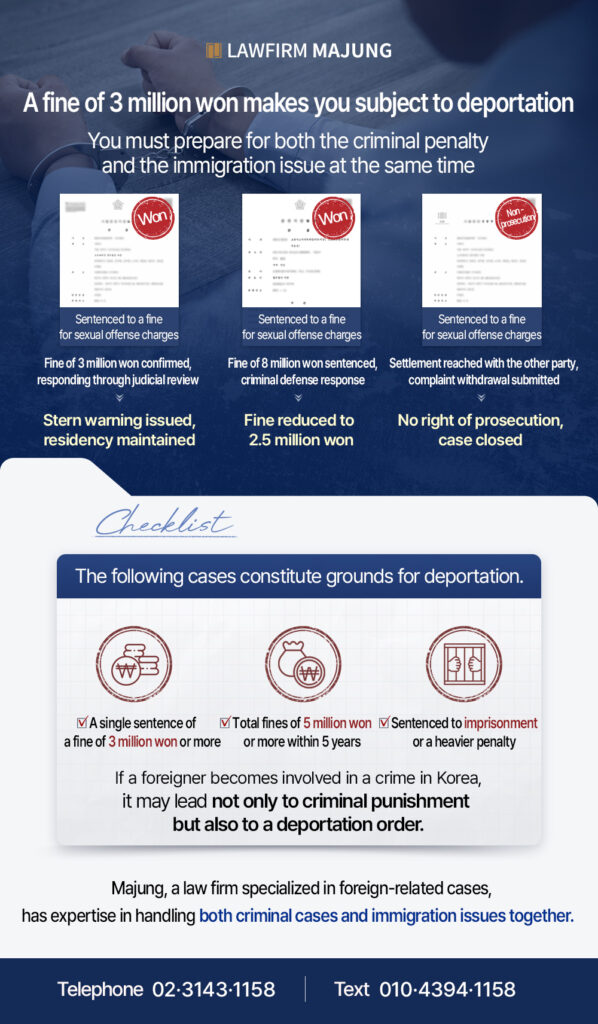
4. How Does a Fine Affect Your Visa?
Receiving a fine after a traffic accident does not necessarily mean the matter has ended.
Following the criminal proceedings, immigration authorities may separately conduct an Immigration Offender Review to determine whether the individual should be permitted to maintain their immigration status.
▶️ During this review, authorities commonly consider:
Just as in cases involving sexual offenses committed by foreign nationals, the criminal outcome and the immigration outcome are reviewed separately. In other words, what happens after the fine is often more important than the fine itself.

5. Key Response Strategies That Can Change the Outcome
The most important factor in these cases is responding appropriately from the earliest stage.
If the initial statements and supporting evidence are not properly prepared, this may lead to:
As with criminal cases involving foreign nationals accused of sexual offenses, traffic accident cases are decided primarily based on objective evidence rather than personal explanations.
Accordingly, careful preparation is essential, including:
A traffic accident involving a foreign national requires a strategy that considers both the criminal proceedings and the Immigration Offender Review.
In other words, the key issue is not simply the fine—it is whether you can continue to remain in Korea.
Even if you have already received official notice from the authorities, opportunities to respond may remain. The key is how quickly and how appropriately you respond. Working with an immigration lawyer to evaluate your temporary detention status and develop a strategy that also considers the possibility of extending your immigration status can make a meaningful difference.